
How to Calculate Pool Turnover Rate: Formula, Examples, and Fixes
Your pool pump runs for hours every day, but is it actually filtering all your water? Learning how to calculate pool turnover rate tells you exactly how long it takes for every drop in your pool to pass through the filter — and whether your pump is doing its job. Get this number wrong, and you’ll fight cloudy water, algae blooms, and wasted electricity all summer long.
Quick answer
How to Calculate Pool Turnover Rate: Formula, Examples, and Fixes: Your pool pump runs for hours every day, but is it actually filtering all your water? Learning how to calculate pool turnover rate tells you exactly how long it takes for every drop in your pool to pass through the.
Quick Answer
Pool turnover rate measures how long it takes your pump and filter system to circulate your entire pool volume one complete time.
The formula:
Turnover Time (hours) = Pool Gallons ÷ Flow Rate (GPM) ÷ 60
Turnovers Per Day = Daily Pump Run Hours ÷ Turnover Time
For most residential pools, you want 2 turnovers per day minimum. Pools with heavy use, lots of debris, or chemical issues benefit from 3-4 turnovers daily.
Quick example: A 15,000-gallon pool with a pump flowing at 50 GPM takes 5 hours for one complete turnover. Run your pump 10 hours daily, and you get 2 full turnovers.
Want to skip the math? Our pool turnover rate calculator handles everything instantly.
Why Turnover Rate Actually Matters
Think of your pool like a giant fish tank. If the filter only processes half the water each day, the other half sits there collecting bacteria, algae spores, and swimmer waste. Gross, right?
Here’s what proper turnover accomplishes:
- Chemical distribution — Chlorine and other sanitizers mix evenly throughout the pool
- Debris removal — Dirt, leaves, and organic matter get pulled to the filter before they decompose
- Algae prevention — Moving water discourages algae growth (they prefer still, warm spots)
- Clarity — Particles stay suspended long enough to get filtered out
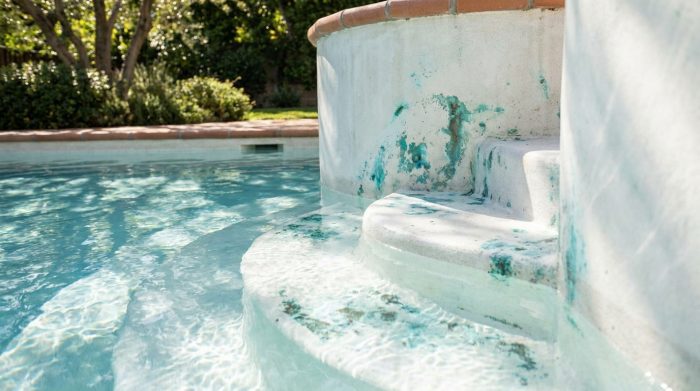
Pools with inadequate turnover develop problems that seem random but aren’t. Dead spots form in corners. Chlorine reads fine at the skimmer but drops to zero at the far end. Algae grows on the steps while the rest of the pool looks clean.
The fix starts with understanding your numbers.
How to Calculate Pool Turnover Rate
Step 1: Find Your Pool Volume
You can’t calculate turnover without knowing how many gallons you’re dealing with. If you don’t know your pool’s volume, use these standard formulas:
Rectangular pools: Length × Width × Average Depth × 7.5 = Gallons
Round pools: Diameter × Diameter × Average Depth × 5.9 = Gallons
Oval pools: Length × Width × Average Depth × 6.7 = Gallons
For irregular shapes or pools with varying depths, our pool volume calculator breaks it into sections for accurate results.
Pro tip: Average depth isn’t just shallow end plus deep end divided by two. Most pools have a slope, so measure at multiple points and average those readings.
Step 2: Determine Your Flow Rate (GPM)
Flow rate measures how many gallons per minute your pump actually moves through your system. This is where most homeowners get tripped up.
Your pump’s labeled horsepower doesn’t tell you flow rate. A 1.5 HP pump might push anywhere from 30-80 GPM depending on:
- Pipe diameter (1.5″ vs 2″ makes a huge difference)
- Total pipe length and number of elbows
- Filter condition (dirty filters restrict flow)
- Pump age and impeller wear
- Elevation changes between pump and pool
Three ways to find your actual flow rate:
- Install a flow meter — The most accurate option. A permanent flow meter installs inline and shows real-time GPM readings.
- Time the skimmer basket — Remove the basket, hold a 5-gallon bucket under the skimmer opening, and time how long it takes to fill. Gallons ÷ seconds × 60 = approximate GPM for that line.
- Use pump curves — Find your pump’s performance curve in the manual. Cross-reference the feet of head (resistance) in your system to estimate GPM. This takes some calculation but works decently.
Our flow rate estimator helps you calculate system resistance and estimate GPM based on your setup.
Step 3: Calculate Your Turnover Time
Now plug your numbers into the formula:
Turnover Time (hours) = Pool Gallons ÷ GPM ÷ 60
That “÷ 60” converts minutes to hours.
Let’s say you have a 20,000-gallon pool and your pump flows at 60 GPM:
20,000 ÷ 60 ÷ 60 = 5.55 hours per turnover
This means your entire pool volume passes through the filter once every 5 hours and 33 minutes.
Step 4: Determine Your Daily Turnovers
Here’s where turnover time becomes actually useful:
Turnovers Per Day = Pump Run Hours ÷ Turnover Time
If you run your pump 8 hours daily with a 5.55-hour turnover time:
8 ÷ 5.55 = 1.44 turnovers per day
That’s below the recommended 2 turnovers. You’d need to either run your pump longer (about 11 hours for 2 turnovers) or increase flow rate.
Step 5: Adjust Your Pump Schedule
Once you know your turnover time, set your pump timer accordingly. Most pools need 8-12 hours of daily run time to achieve proper turnover.
Minimum target: 2 turnovers per day for typical residential pools
Better target: 3-4 turnovers during heavy use, hot weather, or after adding chemicals
For variable-speed pumps, you might run longer hours at lower speeds. A pump running 16 hours at reduced RPM can achieve better turnover than 6 hours at full blast — while using less electricity.
Our pump run time calculator factors in your specific equipment to recommend ideal schedules.
Worked Examples for Common Pool Sizes
10,000-Gallon Pool
Setup: In-ground pool, 40 GPM flow rate
Turnover time: 10,000 ÷ 40 ÷ 60 = 4.17 hours
For 2 turnovers: Run pump 8.3 hours daily
For 3 turnovers: Run pump 12.5 hours daily
A 10,000-gallon pool is relatively small, so even modest pumps achieve decent turnover without marathon run times.
15,000-Gallon Pool
Setup: Vinyl liner pool, 50 GPM flow rate
Turnover time: 15,000 ÷ 50 ÷ 60 = 5 hours
For 2 turnovers: Run pump 10 hours daily
For 3 turnovers: Run pump 15 hours daily
This is a common size for suburban backyards. Ten hours of pump time keeps the water moving without crushing your electric bill.
20,000-Gallon Pool
Setup: Plaster pool, 60 GPM flow rate
Turnover time: 20,000 ÷ 60 ÷ 60 = 5.55 hours
For 2 turnovers: Run pump 11 hours daily
For 3 turnovers: Run pump 16.7 hours daily
At this size, flow rate becomes increasingly important. Bumping from 60 to 70 GPM would drop turnover time to 4.76 hours, saving you run time.
30,000-Gallon Pool
Setup: Large pool, 75 GPM flow rate
Turnover time: 30,000 ÷ 75 ÷ 60 = 6.67 hours
For 2 turnovers: Run pump 13.3 hours daily
For 3 turnovers: Run pump 20 hours daily
Big pools face real challenges. At 6.67 hours per turnover, you’re running almost continuously to achieve 3 turnovers. This is where variable-speed pumps pay for themselves — they can run 20+ hours at low speed more cheaply than 13 hours at full speed.
Troubleshooting Common Turnover Problems
Low Turnover Despite Long Run Times
Symptoms: You run the pump 12 hours but still see cloudy water and uneven chlorine levels.
Likely causes:
- Actual flow rate is lower than you think
- Clogged or undersized pipes restricting flow
- Worn pump impeller reducing efficiency
- Return jets pointed wrong (water bypasses main areas)
Fixes:
- Install a flow meter to measure actual GPM
- Clean pump strainer and impeller
- Check for air leaks reducing pump efficiency
- Aim returns to create circular current, hitting all corners
Cloudy Water Despite Good Turnover
Symptoms: Numbers look fine, but water won’t clear.
This usually isn’t a turnover problem — it’s chemistry or filtration. Test your water using reliable pool test strips to check:
- Combined chlorine (chloramines) — shock if over 0.5 ppm
- pH — optimal range 7.2-7.6
- Alkalinity — keep 80-120 ppm
- Calcium hardness — 200-400 ppm
If chemistry checks out, your filter media might need replacement or deep cleaning with a filter cleaning solution.
Weak Returns and Poor Circulation
Symptoms: Water dribbles from jets instead of pushing firmly.
Check these:
- Filter pressure — high reading means dirty filter, clean or backwash
- Pump basket — debris restricts intake
- Skimmer basket — leaves blocking flow
- Air in system — reduces pump efficiency
Adding skimmer socks catches fine debris before it reaches your pump, reducing clogs and maintaining better flow.
Dirty Filter Despite Regular Cleaning
Symptoms: Pressure spikes within days of cleaning.
Your filter isn’t the problem — it’s too much debris reaching it. Consider:
- Running the pump longer to catch debris before it settles
- Adding a secondary skimmer
- Using skimmer socks as pre-filters
- Checking for organic contamination (phosphates feeding algae growth)
Our pool forecast tool can help predict when chemistry issues might cause debris problems.
Low GPM Readings
Symptoms: Flow meter shows lower numbers than expected.
Systematic approach:
- Clean pump strainer basket
- Backwash or clean filter
- Check for air leaks at pump lid, valves, and unions
- Inspect impeller for clogs or damage
- Verify pipe sizing matches pump requirements
Air Leaks Reducing Efficiency
Symptoms: Air bubbles in pump basket, sputtering returns, pump loses prime.
Air enters the suction side (between pool and pump). Check:
- Pump lid O-ring — cracked rings let air in
- Valve stems — tighten bonnet nuts
- Pipe unions — hand-tighten plus quarter turn
- Skimmer weir — stuck open exposes air when water drops
Variable-Speed Pump Settings
Symptoms: Not sure what speed to run.
Variable-speed pumps throw a wrinkle into turnover calculations. Here’s the key insight: energy usage drops exponentially with speed, but flow rate drops linearly.
Running at 50% speed uses only about 12.5% of the electricity while maintaining 50% of the flow. So you can run twice as long for roughly the same cost as high-speed — and get better filtration.
Strategy: Calculate turnover at your preferred RPM, then adjust run time accordingly. Many variable-speed owners run 12-18 hours at medium-low speed, achieving 3+ turnovers while spending less than 6 hours at full speed.
Safety Reminder
Before opening any pool equipment: Shut off the pump at the breaker, not just the timer. Capacitors in pump motors can hold charge even when “off.”
For electrical issues — breakers tripping, burnt smell from motor, exposed wiring, or ground faults — call a licensed electrician or certified pool technician. Water and electricity don’t mix, and pool equipment operates on 240V in most cases. Not worth the risk.
Get Your Numbers Right the First Time
Calculating pool turnover rate by hand works fine, but it’s easy to make mistakes — especially when adjusting for variable-speed settings or unusual pool shapes.
The Pool Calculator app handles turnover calculations automatically. Enter your pool specs once, and it tracks everything: volume, flow rate, recommended run times, and chemical doses based on your actual turnover. No more guessing, no more spreadsheets.
Frequently Asked Questions
How many turnovers per day does a pool need?
Most residential pools need a minimum of 2 complete turnovers every 24 hours. During heavy swim season, after parties, or when treating water problems, bump that to 3-4 turnovers. Commercial pools typically require even more — up to 6 turnovers daily depending on bather load and health codes.
What’s a good flow rate for a residential pool?
For typical pools between 10,000-25,000 gallons, aim for 40-80 GPM. This achieves reasonable turnover times (4-8 hours) without requiring 20-hour run times. Larger pools over 30,000 gallons often need 80-100+ GPM or accept longer daily pump operation.
Does running the pump longer improve water quality?
Yes, up to a point. More turnovers mean more filtration passes and better chemical distribution. But after 4-5 turnovers daily, benefits diminish while electricity costs keep climbing. Focus on quality filtration and proper chemistry rather than endless run time.
Can turnover rate be too high?
Technically yes, but you’d need oversized commercial equipment to hit problematic levels in a home pool. Very high turnover (6+ per day) doesn’t hurt water quality — it just wastes electricity. Match your turnover to your actual needs.
How does water temperature affect turnover needs?
Warmer water grows algae faster, chlorine degrades quicker, and bacteria multiply more readily. When water temperature exceeds 85°F, consider adding one extra turnover to your daily target. The Pool Calculator app adjusts recommendations based on temperature and other variables.
Make Pool Math Easy
Stop guessing about your pool’s turnover rate. Grab the free Pool Calculator app and enter your pool’s details once. You’ll get precise turnover calculations, customized pump schedules, and chemical dosing recommendations that actually match your water — not some generic chart. Your pool stays clear, your pump runs efficiently, and you spend less time chasing problems.
Recommended pool supplies
As an Amazon Associate, Pool Chemical Calculator earns from qualifying purchases.

A clean cartridge improves circulation and helps cloudy water clear faster.
View on Amazon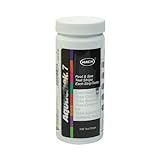
Fast daily checks between full liquid tests, especially during heavy swim season.
View on Amazon
Raises calcium hardness to reduce corrosive water risk in plaster, concrete, and equipment.
View on AmazonGet exact pool chemical doses
Pool Chemical Calculator turns your test readings, pool volume, and target levels into exact treatment amounts for chlorine, pH, alkalinity, calcium, stabilizer, salt, and more.
Open the Pool Chemical Calculator app for iOS, Android, or web.