
Pool Turnover Rate Calculator: The Simple Formula for Clear Pool Water
Quick Answer: A pool turnover rate calculator tells you how long your pump takes to move one full pool volume through the filter. Use this formula: pool gallons / flow rate GPM / 60 = hours per turnover. Then use daily pump runtime / hours per turnover = turnovers per day. Most backyard pools do best at about 1-2 turnovers per day, with higher runtime during storms, algae cleanup, heavy swimming, or very hot weather.
Quick answer
Pool Turnover Rate Calculator: The Simple Formula for Clear Pool Water: Quick Answer: A pool turnover rate calculator tells you how long your pump takes to move one full pool volume through the filter. Use this formula: pool gallons / flow rate GPM / 60 = hours per turnover . Then use.
If your 15,000-gallon pool flows at 40 GPM, one full turnover takes 6.25 hours. Run that pump for 10 hours and you get 1.6 turnovers per day. Run it for only 4 hours and you get 0.64 turnovers, which means a lot of water never gets filtered that day.
That is why turnover matters. You can test perfect chlorine, pH, alkalinity, and stabilizer, but if the pump is not moving enough water, debris and algae spores sit in dead areas while the filter does only part of the job.
Pool Turnover Rate Formula
There are two useful formulas.
1. Hours Per Turnover
Pool gallons / flow rate GPM / 60 = hours per turnover
Example:
- Pool volume: 20,000 gallons
- Actual flow rate: 50 GPM
- Calculation: 20,000 / 50 / 60 = 6.67 hours per turnover
That means the pump needs about 6 hours and 40 minutes to move one pool volume through the system.
2. Turnovers Per Day
Daily pump runtime / hours per turnover = turnovers per day
Example:
- Daily runtime: 10 hours
- Hours per turnover: 6.67 hours
- Calculation: 10 / 6.67 = 1.5 turnovers per day
That is a solid residential target for normal summer use.
If you do not know your pool volume, start with the Pool Volume Calculator. If you do not know your actual GPM, use the Flow Rate Calculator.
Pool Turnover Rate Calculator Chart
Use this chart for a fast estimate. These numbers show how long one full turnover takes.
| Pool Size | 30 GPM | 40 GPM | 50 GPM | 60 GPM |
|—|—:|—:|—:|—:|
| 10,000 gallons | 5.6 hours | 4.2 hours | 3.3 hours | 2.8 hours |
| 15,000 gallons | 8.3 hours | 6.25 hours | 5.0 hours | 4.2 hours |
| 20,000 gallons | 11.1 hours | 8.3 hours | 6.7 hours | 5.6 hours |
| 25,000 gallons | 13.9 hours | 10.4 hours | 8.3 hours | 6.9 hours |
Now compare that to your daily runtime.
| Pool Size | Flow Rate | 8-Hour Runtime | 10-Hour Runtime | 12-Hour Runtime |
|—|—:|—:|—:|—:|
| 10,000 gallons | 40 GPM | 1.9 turnovers | 2.4 turnovers | 2.9 turnovers |
| 15,000 gallons | 40 GPM | 1.3 turnovers | 1.6 turnovers | 1.9 turnovers |
| 20,000 gallons | 40 GPM | 1.0 turnover | 1.2 turnovers | 1.4 turnovers |
| 25,000 gallons | 40 GPM | 0.8 turnovers | 1.0 turnover | 1.2 turnovers |
The takeaway is simple: big pools with low flow need long runtimes. If a 25,000-gallon pool only flows at 40 GPM, an 8-hour schedule is usually not enough.
For day-to-day scheduling, pair this math with the Pool Pump Run Time Calculator.
What Is a Good Pool Turnover Rate?
For most residential pools:
- 0.5-1 turnover per day: cold water, covered pool, very light use
- 1-1.5 turnovers per day: mild weather and clear water
- 1.5-2 turnovers per day: normal swimming season
- 2-3 turnovers per day: heavy use, storms, high heat, lots of leaves, algae prevention
- 24-hour circulation temporarily: active algae treatment, floc cleanup, or major debris removal
One turnover per day is a bare minimum for many backyard pools. In real life, 1.5 turnovers per day is a better starting point during swimming season because skimmers, returns, and filters are not perfect. Some water always mixes faster than other water.
How to Calculate Your Pool Turnover Rate
Follow these steps when you want a real number instead of a timer guess.
Step 1: Find Your Pool Volume
Use measured dimensions, not the number someone guessed when the pool was installed.
Common formulas:
- Rectangle: length x width x average depth x 7.5 = gallons
- Round: diameter x diameter x average depth x 5.9 = gallons
- Oval: length x width x average depth x 6.7 = gallons
Example for a rectangular pool:
16 ft x 32 ft x 5 ft average depth x 7.5 = 19,200 gallons
If your pool has an irregular shape, use the Pool Volume Calculator so your chemical doses and pump math use the same gallon number.
Step 2: Find Your Actual Flow Rate
The pump label does not tell you the real flow rate in your plumbing. Actual GPM depends on pipe size, filter condition, valve position, suction restrictions, heater resistance, plumbing length, and how clean the baskets are.
Better ways to estimate flow:
- Install an inline pool flow meter.
- Use the Flow Rate Calculator if you have measured system data.
- Use a conservative estimate from pump size only when you have no better option.
Typical real-world ranges:
- 0.75 HP pump: 30-40 GPM
- 1.0 HP pump: 40-50 GPM
- 1.5 HP pump: 50-65 GPM
- 2.0 HP pump: 60-80 GPM
If your filter pressure is unknown or the gauge is stuck, replace it with a basic pool filter pressure gauge. A bad gauge makes turnover troubleshooting harder than it needs to be.
Step 3: Calculate One Turnover
Use:
pool gallons / flow rate GPM / 60 = hours per turnover
Example:
- Pool volume: 19,200 gallons
- Actual flow: 48 GPM
- Calculation: 19,200 / 48 / 60 = 6.67 hours
That pool needs about 6 hours and 40 minutes for one complete turnover.
Step 4: Pick a Daily Turnover Target
Use 1.5 turnovers as a normal summer starting point.
Example:
- One turnover: 6.67 hours
- Target: 1.5 turnovers
- Daily runtime: 6.67 x 1.5 = 10 hours
If the pool gets heavy use or the water is starting to cloud, move closer to 2 turnovers:
6.67 x 2 = 13.3 hours
Step 5: Set the Timer and Watch the Water
Set your schedule with a programmable pool timer, then watch the water for a week.
If the pool stays clear, chlorine holds, and debris is not sitting in corners, the schedule is probably close. If water gets dull, chlorine disappears fast, or algae starts in low-circulation spots, increase runtime by 1-2 hours and recheck filter pressure.
The Pool Chemical Calculator app helps you keep the pool volume, flow rate, pump runtime, and chemistry math in one place.
Troubleshooting a Low Pool Turnover Rate
If your math says you are getting less than one turnover per day, do not just dump in more chlorine. Fix circulation first.
1. Clean the Filter
A dirty filter can cut flow hard. Cartridge filters should be rinsed when pressure rises 8-10 PSI above clean pressure. Sand and DE filters should be backwashed when they hit the same 8-10 PSI rise.
Check:
- Filter pressure compared with clean baseline
- Weak return jets
- Dirty cartridge pleats
- Sand or DE filter overdue for backwash
- Old filter media that no longer cleans well
2. Empty the Skimmer and Pump Baskets
Leaves, seed pods, toys, and hair can restrict suction before water ever reaches the pump.
Turn the pump off, empty the baskets, reseat the pump lid O-ring, and restart. If the pump basket fills more completely and returns get stronger, you found part of the problem.
3. Check Valves and Suction Settings
A partially closed suction or return valve can make a healthy pump act undersized.
Make sure:
- Skimmer valves are open
- Main drain valve is not accidentally closed when needed
- Return valves are open
- Cleaner line valves are not stealing too much flow
- Water level is halfway up the skimmer opening
4. Look for Air Leaks
Air in the pump basket means the pump is pulling air on the suction side. That reduces flow and can make turnover calculations look terrible.
Common causes:
- Dry or cracked pump lid O-ring
- Loose pump drain plugs
- Low water level
- Cracked suction fitting
- Loose union or valve seal
5. Increase Runtime or Upgrade Equipment
If the system is clean and flow is still low, the pool may need longer runtime, a variable-speed pump, larger plumbing, or a filter upgrade. Do the cheap checks first. Then use the turnover math to decide whether the equipment is actually undersized.
Pool Turnover Rate and Chemical Efficiency
Turnover rate does not replace water chemistry, but it makes chemistry work better.
Good circulation helps:
- Chlorine spread evenly
- pH and alkalinity readings stabilize
- Shock treatments reach the whole pool
- Fine debris reach the filter
- Dead spots disappear around steps, benches, and corners
Poor circulation does the opposite. You end up adding more sanitizer because the filter is not removing enough organic load. That is expensive and frustrating.
Before making chemical adjustments, test the water and calculate doses with Pool Chemical Calculator. The smart app link is here: https://poolchemicalcalculator.com/app.
FAQ
How many turnovers per day does a pool need?
Most residential pools need about 1-2 turnovers per day. A clear, covered pool in mild weather may be fine near 1 turnover. A busy summer pool usually does better around 1.5-2 turnovers.
Is one pool turnover per day enough?
Sometimes, but it is the low end. One turnover may work when the water is cold, covered, and lightly used. During hot weather, storms, algae recovery, or heavy swimming, one turnover often is not enough.
How do I calculate pool turnover rate from GPM?
Divide pool gallons by flow rate in GPM, then divide by 60. That gives hours per turnover. Then divide your daily pump runtime by hours per turnover to get turnovers per day.
Why is my turnover rate too low even though my pump is running?
The usual causes are low actual GPM, a dirty filter, clogged baskets, partially closed valves, suction-side air leaks, undersized plumbing, or a pump schedule that is too short for the pool volume.
Should I run my pool pump 24 hours a day?
Not usually. Running 24 hours can help during algae treatment or major cleanup, but most residential pools can stay clear with a calculated runtime that delivers 1-2 turnovers per day. A variable-speed pump can run longer at lower speeds without wasting as much power.
Final Takeaway
Turnover rate is not a magic rule. It is a practical check on whether your pump and filter are doing enough work for your pool size.
Start with the formula:
pool gallons / GPM / 60 = hours per turnover
Then set your daily runtime to deliver the turnover target your pool actually needs.
For exact pool volume, flow, pump runtime, and chemical dosing, use Pool Chemical Calculator on your phone: https://poolchemicalcalculator.com/app.
Recommended pool supplies
As an Amazon Associate, Pool Chemical Calculator earns from qualifying purchases.
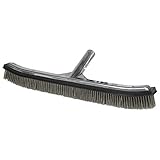
Brushing breaks up algae films, dead spots, and wall buildup so chemicals and filtration work.
View on Amazon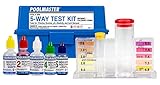
Accurate readings make every chlorine, pH, alkalinity, calcium, and CYA dose safer.
View on Amazon
Helps small particles clump together so the filter can clear cloudy water faster.
View on AmazonGet exact pool chemical doses
Pool Chemical Calculator turns your test readings, pool volume, and target levels into exact treatment amounts for chlorine, pH, alkalinity, calcium, stabilizer, salt, and more.
Open the Pool Chemical Calculator app for iOS, Android, or web.