
Muriatic Acid Pool Calculator: Exact Dosing to Lower pH and Alkalinity Safely
Keyword: muriatic acid pool calculator
Quick answer
Muriatic Acid Pool Calculator: Exact Dosing to Lower pH and Alkalinity Safely: Keyword: muriatic acid pool calculator Quick Answer For a 10,000-gallon pool using standard 31.45% muriatic acid, lowering pH from 8.0 to about 7.4 usually takes roughly 12-16 fluid ounces. If you are using.
Quick Answer
For a 10,000-gallon pool using standard 31.45% muriatic acid, lowering pH from 8.0 to about 7.4 usually takes roughly 12-16 fluid ounces. If you are using reduced-strength “safer” acid around 14.5%-15.7%, the dose can be close to double. Exact dosing depends on pool volume, current pH, target pH, total alkalinity, and acid strength.
The simplest path: test pH and total alkalinity, confirm your gallons, choose the acid strength on the label, then calculate before pouring. Use the Pool Chemical Calculator pH calculator or the Pool Chemical Calculator app to get the exact dose for your pool.
Muriatic acid is one of the most useful pool chemicals, but it is also one of the easiest to overdo. A muriatic acid pool calculator keeps you from turning a simple pH correction into low-pH water, irritated swimmers, etched plaster, damaged heaters, or a second chemical adjustment you did not need.
Most pools need acid when pH rises above 7.6 or total alkalinity climbs above the ideal range. The catch is that acid strength changes the math. A gallon of 31.45% muriatic acid is not the same treatment as a gallon of 15% acid. If the label says “safer,” “low fume,” or “green,” read the concentration before using a standard dosing chart.
When to Use Muriatic Acid in a Pool
Use muriatic acid when your pool pH is too high, total alkalinity is too high, or both. In most residential pools, the target ranges are:
- pH: 7.2-7.6
- Total alkalinity: 80-120 ppm
- Free chlorine: depends on stabilizer level, but most pools need 2-5 ppm
High pH makes chlorine less effective, encourages scale, clouds water, and can leave swimmers with itchy skin or irritated eyes. High alkalinity makes pH stubborn. You add acid, pH drops for a day, then it creeps right back up.
If pH is high but alkalinity is normal, the fix is usually a smaller acid dose with the pump running. If alkalinity is high, you may need repeated acid/aeration cycles over several days.
Why Acid Strength Changes the Dose
Pool acid is sold in different concentrations. That matters more than the brand name.
| Acid Type | Typical Label | What It Means |
|—|—|—|
| Full-strength muriatic acid | 31.45% or 20 Baume | Standard dosing charts usually assume this strength |
| Reduced-strength muriatic acid | 14.5%-15.7% | Lower fumes, but you need more product |
| Dry acid | Sodium bisulfate | Granular pH reducer, different dosing math |
If a chart says to add 16 ounces of 31.45% muriatic acid, a 15% acid product may need about 32 ounces for a similar pH change. That is why exact calculators beat memorized rules.
Use the pH calculator and select the acid type you actually have. If you are not sure how many gallons are in the pool, run the pool volume calculator first. Bad volume estimates create bad chemical doses.
Muriatic Acid Dosage Chart
These are rough starting estimates for standard 31.45% muriatic acid. They assume normal alkalinity. High alkalinity can require more acid, while low alkalinity can make pH drop faster than expected.
Approximate Acid Dose for 10,000 Gallons
| Current pH | Target pH | Estimated Dose |
|—|—:|—:|
| 7.8 | 7.4 | 6-10 oz |
| 8.0 | 7.4 | 12-16 oz |
| 8.2 | 7.4 | 16-22 oz |
| 8.4 | 7.4 | 22-30 oz |
Approximate Acid Dose for 20,000 Gallons
| Current pH | Target pH | Estimated Dose |
|—|—:|—:|
| 7.8 | 7.4 | 12-20 oz |
| 8.0 | 7.4 | 24-32 oz |
| 8.2 | 7.4 | 32-44 oz |
| 8.4 | 7.4 | 44-60 oz |
If your calculated dose is more than one quart, split the treatment. Add part of the dose, circulate, retest, then continue if needed. It is much easier to add more acid than to recover from pH that dropped too far.
Step-by-Step: How to Add Muriatic Acid to a Pool
Step 1: Test pH and Total Alkalinity
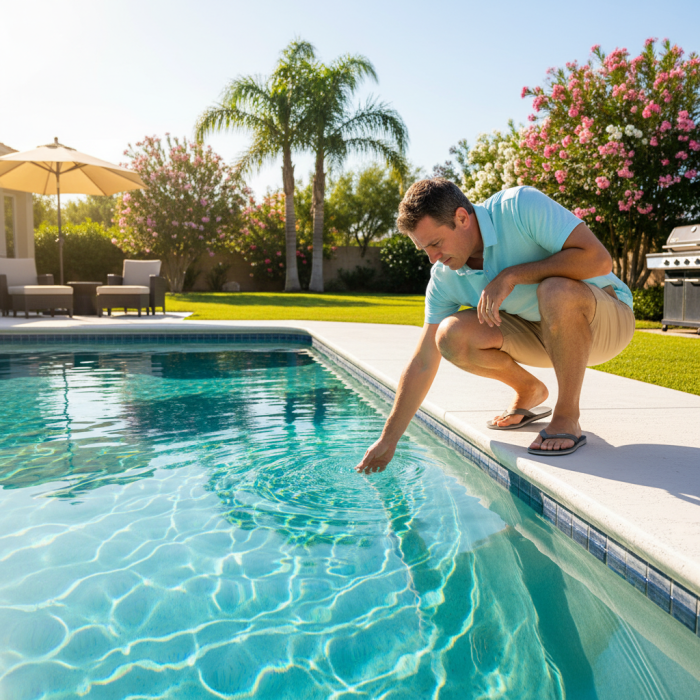
Do not dose acid from memory. Test pH and total alkalinity first. A good liquid kit such as the Taylor K-2006 pool test kit is more reliable than old strips that sat in a humid shed all summer.
Write down both readings. You need pH to calculate the immediate correction, and alkalinity to understand whether pH will fight you.
Step 2: Confirm Pool Volume
Chemical dosing starts with gallons. A pool that looks like 15,000 gallons might actually be 18,000 gallons once you account for depth, steps, and shape. Use the pool volume calculator if you are guessing.
Step 3: Choose the Correct Acid Strength
Check the label. If it says 31.45% or 20 Baume, use the standard muriatic acid setting. If it says 14.5%, 15.7%, low fume, or safer acid, use the reduced-strength setting. Do not use a full-strength dose for half-strength acid unless the calculator tells you to.
Step 4: Put on Safety Gear
Wear chemical splash goggles, acid-resistant gloves, long pants, and closed-toe shoes. Muriatic acid fumes are harsh, and splashes can burn skin or eyes. Useful basics include chemical splash goggles and acid-resistant gloves.
Work outside, stay upwind, and keep children and pets away from the pool area.
Step 5: Add Acid Slowly With the Pump Running
For a normal pH correction, keep the pump running and slowly pour acid in a thin stream near a return jet or around the deep end. Keep the jug close to the water surface to reduce splashing. Never pour acid into the skimmer.
If you pre-dilute in a bucket, add acid to water, never water to acid. Use a clean plastic bucket with pool water, pour slowly, and avoid breathing fumes.
Step 6: Circulate for 1-2 Hours
Run the pump continuously after adding acid. Brush nearby walls and floors with a pool brush if you poured near a surface or see any area where acid may have concentrated.
Do not retest immediately. Fresh acid needs time to mix through the full water volume.
Step 7: Retest Before Adding More
Retest pH after 1-2 hours of circulation, or the next morning after a larger dose. If pH is still above 7.6, calculate a second smaller dose. If pH lands between 7.2 and 7.6, stop.
How to Lower Total Alkalinity With Muriatic Acid
Lowering alkalinity is different from making one simple pH adjustment. Acid lowers both pH and alkalinity, so the trick is to reduce alkalinity without leaving pH too low for too long.
Use this process:
- Test pH and total alkalinity.
- Use the alkalinity calculator to estimate the acid needed.
- Add acid in a controlled dose.
- Circulate until pH drops near 7.0-7.2.
- Aerate the pool with returns, waterfalls, spa jets, or an air compressor to raise pH without raising alkalinity.
- Retest and repeat until alkalinity is in range.
Do not try to drop alkalinity from 180 ppm to 100 ppm in one aggressive treatment. Multiple smaller rounds are safer for plaster, vinyl, heaters, ladders, and swimmers.
Troubleshooting Acid Dosing Problems
pH Did Not Drop Enough
High total alkalinity is the usual reason pH barely moves. Alkalinity buffers pH, so a pool at 180 ppm may need more acid than a pool at 90 ppm. Confirm your acid strength too. Reduced-strength acid can look like it “did not work” when the dose was calculated for 31.45% acid.
pH Dropped Too Low
If pH falls below 7.0, stop adding acid and circulate. Raise pH with soda ash if needed. A common rule of thumb is 6 ounces of soda ash per 10,000 gallons to raise pH by about 0.2, but use the pH calculator rather than guessing again.
pH Keeps Rising Back Up
Recurring high pH usually points to high alkalinity, new plaster curing, saltwater chlorine generator aeration, water features, spillovers, or fill water with high alkalinity. Test your tap water if you top off often. You may not have an acid problem. You may have a source-water problem.
Water Turned Cloudy After Acid
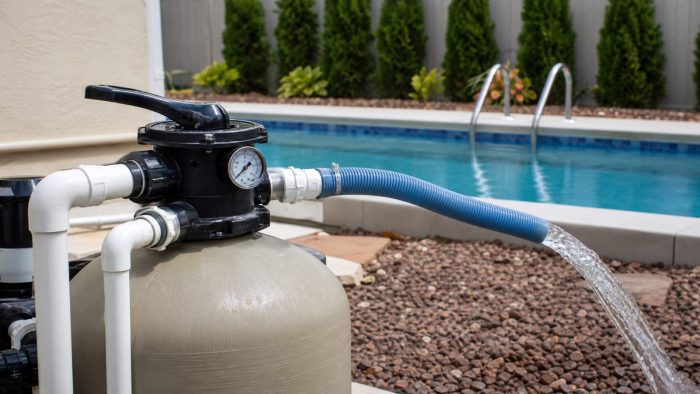
Acid itself does not usually cloud water. Cloudiness after pH correction often means calcium scale was already forming, the filter is dirty, or the pool needs longer circulation. Test calcium hardness, pH, and alkalinity together. If filter pressure is high, clean or backwash the filter.
Acid Fumes Are Too Strong
Do not tough it out. Step away, move upwind, and close the container. Switch to reduced-fume acid or dry acid if fumes bother you. Store acid away from chlorine, metal tools, heaters, and electrical equipment. Acid fumes can corrode metal even when the cap is closed.
Muriatic Acid Safety Rules
Muriatic acid deserves respect. These are not optional:
- Never mix muriatic acid with chlorine, shock, tablets, cal-hypo, bleach, or algaecide.
- Never store acid beside chlorine products.
- Never add water to acid.
- Never pour acid into the skimmer.
- Never add acid while people are swimming.
- Never guess a large dose because you are in a hurry.
For small skin exposure, rinse with water for at least 15 minutes. For eye contact, flush with clean water and seek medical help. For a chemical spill, follow the product label and local guidance.
Useful Supplies
You do not need a garage full of gear, but a few basics make acid handling safer and more accurate:
Amazon links above use the Pool Chemical Calculator affiliate tag and may earn a commission at no extra cost to you.
App CTA: Calculate the Exact Acid Dose
Pool acid dosing should be boring, exact, and repeatable. The free Pool Chemical Calculator app handles pool volume, current reading, target reading, acid type, and chemical strength so you can stop doing risky math beside the water.
Use the smart app link here: https://poolchemicalcalculator.com/app
It detects iOS or Android automatically and also includes calculators for chlorine, pH, alkalinity, stabilizer, calcium hardness, salt, volume, heating, flow rate, and more.
Frequently Asked Questions
How much muriatic acid do I add to lower pool pH?
For a 10,000-gallon pool with standard 31.45% muriatic acid, lowering pH from 8.0 to around 7.4 often takes about 12-16 ounces. Treat that as a starting estimate, not a rule. Total alkalinity, acid strength, pool volume, and test accuracy all change the dose.
Can I swim after adding muriatic acid?
Wait at least 30 minutes with the pump running after a small acid dose. For larger doses, wait 1-2 hours and retest pH before swimming. The water should be mixed, clear, and in the normal pH range.
Can I add muriatic acid and chlorine on the same day?
Yes, but never at the same time or in the same spot. Acid and chlorine can create dangerous chlorine gas when mixed directly. Add one chemical, circulate for at least 30 minutes, then add the other if testing says it is needed.
Is 20 Baume the same as 31.45% muriatic acid?
For pool dosing, yes. A 20 Baume muriatic acid label usually corresponds to about 31.45% hydrochloric acid. Use the standard full-strength muriatic acid setting in your calculator.
Is dry acid safer than muriatic acid?
Dry acid is easier to store and has fewer fumes, but it is still acidic and needs careful handling. It can also add sulfates to the water over time. Muriatic acid is usually cheaper and better for large alkalinity corrections, while dry acid is convenient for smaller pH adjustments.
Recommended pool supplies
As an Amazon Associate, Pool Chemical Calculator earns from qualifying purchases.

Lowers high pH and helps bring alkalinity down when used carefully.
View on Amazon
Accurate readings make every chlorine, pH, alkalinity, calcium, and CYA dose safer.
View on Amazon
Raises low pH to protect swimmers, plaster, liners, heaters, and metal equipment.
View on AmazonGet exact pool chemical doses
Pool Chemical Calculator turns your test readings, pool volume, and target levels into exact treatment amounts for chlorine, pH, alkalinity, calcium, stabilizer, salt, and more.
Open the Pool Chemical Calculator app for iOS, Android, or web.