
Pool Calcium Hardness Too Low: How to Fix It Before It Damages Your Pool
If your pool calcium hardness too low reading has you concerned, you’re right to act fast. Low calcium doesn’t just make your water “soft” — it makes your water hungry. Water with too little calcium will pull minerals from whatever it touches: plaster, grout, concrete, metal fittings. Left unchecked, you end up with pitted walls, etched plaster, dissolved grout lines, and corroded equipment. The good news? It’s one of the easier problems to fix once you know what you’re dealing with.
Quick answer
Pool Calcium Hardness Too Low: How to Fix It Before It Damages Your Pool: If your pool calcium hardness too low reading has you concerned, you’re right to act fast. Low calcium doesn’t just make your water “soft” — it makes your water hungry. Water with too little calcium will pull minerals.
What Is Calcium Hardness and Why It Matters
Calcium hardness measures the concentration of dissolved calcium in your pool water, expressed in parts per million (ppm). It’s part of the “hardness” that comes from mineral content — calcium and magnesium salts that naturally occur in water.
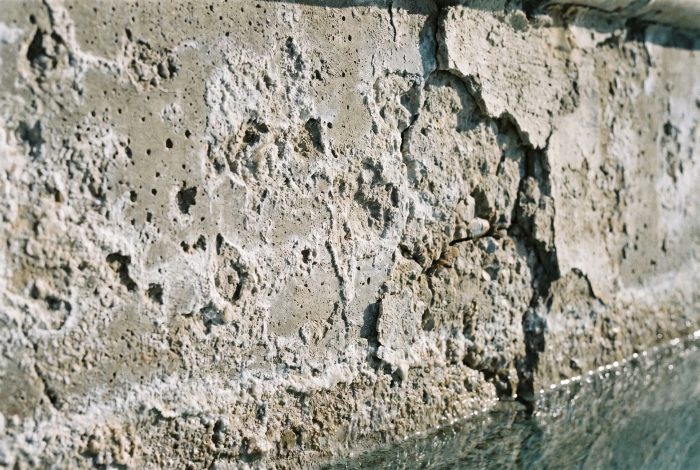
Your pool water is always seeking chemical equilibrium. When calcium is low, the water becomes “aggressive” — it tries to find balance by dissolving calcium from nearby surfaces. For a concrete or plaster pool, that means the walls and floor slowly get eaten away. Fiberglass pools are especially vulnerable because their gel coat can blister and craze when exposed to soft water over time.
Think of it like this: water with enough calcium is satisfied. Water without it is hungry and it’ll eat your pool to compensate.
Ideal Calcium Hardness Levels
The right target depends on your pool surface:
- Concrete, plaster, and gunite pools: 200–400 ppm (300 ppm is a solid target)
- Fiberglass pools: 150–250 ppm (fiberglass is more sensitive to swings in either direction)
- Vinyl liner pools: 150–250 ppm (the liner itself is fine, but metal fittings and equipment can corrode)
Below 150 ppm is urgent. That’s the threshold where aggressive water damage accelerates noticeably. If you’re testing at 100 ppm or below, treat it as a priority this week.
Above 400–500 ppm you flip into the opposite problem — scale buildup, cloudy water, rough surfaces. So don’t over-correct.
Signs Your Calcium Hardness Is Too Low
You might notice these before you even grab a test kit:
- Foamy or frothy water — low calcium contributes to water that foams easily, especially around returns and jets
- Rough or pitted pool walls — run your hand along the plaster; pitting feels like sandpaper or small craters
- Etched or chalky-white surface — especially visible on steps and shallow areas
- Dissolved grout lines in tiled pools
- Corrosion on metal fittings, ladders, or heater components
- Fiberglass blistering — bubbles or soft spots in the gel coat surface
If your pool is newer and already showing these signs, check calcium first. It’s often the culprit.
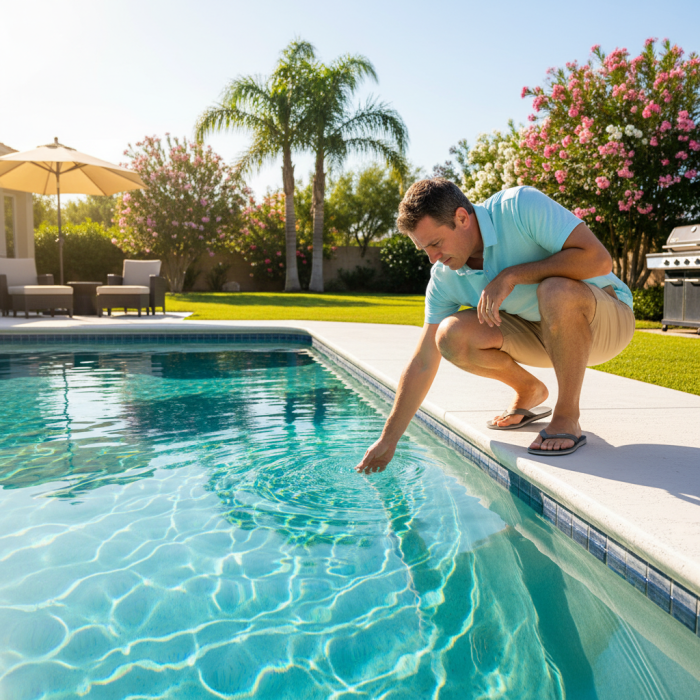
How to Test Calcium Hardness
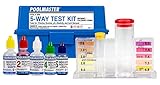
A reliable test is non-negotiable here. Strip tests aren’t accurate enough for calcium — you want a proper liquid drop test or a digital reader.
The Taylor K-2006 Complete Test Kit is the industry standard for serious pool owners. It tests calcium hardness, pH, chlorine, cyanuric acid, alkalinity, and more. One kit, everything covered.
If you prefer a quick digital option, the LaMotte ColorQ Pro 7 Digital Pool Tester eliminates color-matching guesswork and gives you precise digital readings.
Test every 2 weeks during swimming season, and always after heavy rain (which dilutes calcium) or a partial drain-and-refill.
How to Raise Calcium Hardness
The product you want is calcium chloride — not lime, not calcium carbonate. Calcium chloride (CaCl₂) dissolves quickly, raises calcium without significantly affecting pH, and is widely available. You’ll find it as a pool “Calcium Hardness Increaser” or generic calcium chloride flakes/pellets.
Step-by-Step: Adding Calcium Chloride
1. Test your current calcium level — know your starting point before adding anything
2. Calculate how much you need (see formula below)
3. Pre-dissolve the calcium chloride — never add granules directly to the pool. Fill a 5-gallon bucket with pool water, then slowly add the calcium chloride to the water (not water to calcium chloride — it gets hot). Stir until dissolved.
4. Add the solution to the pool — pour it slowly around the perimeter while the pump is running
5. Run the pump for at least 4 hours after adding
6. Wait 24–48 hours, then re-test before adding any more
Important: Calcium chloride dissolves exothermically — it generates heat. The bucket-dissolution step prevents localized heat damage to pool surfaces and ensures even distribution.
Products to Use
The Clorox Pool&Spa Calcium Hardness Increaser comes in a 4 lb bag and works well for moderate corrections. For larger deficits, the In The Swim Calcium Hardness Increaser (25 lbs) is the better value — you’ll go through a full bag fast if you’re starting from 100 ppm.
How Much Calcium Chloride to Add
Here’s the general formula:
> Pounds needed = (Target ppm − Current ppm) × Pool gallons × 0.0006
A few worked examples:
- 20,000-gallon pool, current 100 ppm, target 250 ppm:
(250 − 100) × 20,000 × 0.0006 = 1.8 lbs
- 30,000-gallon pool, current 80 ppm, target 300 ppm:
(300 − 80) × 30,000 × 0.0006 = 3.96 lbs (round up to 4 lbs)
- 15,000-gallon pool, current 150 ppm, target 250 ppm:
(250 − 150) × 15,000 × 0.0006 = 0.9 lbs
These are estimates based on 77% purity calcium chloride (standard for pool products). If you’re using a product with different purity, adjust accordingly. And always add in increments — add 75% of your calculated amount, wait 24–48 hours, re-test, then fine-tune.
> Don’t know your pool’s volume? Use the Pool Chemical Calculator app to get an instant, accurate dose based on your exact pool size and surface type.
Get Your Exact Dose in Seconds
Stop guessing with the formula. Get a precise answer.
The Pool Chemical Calculator calculates the exact amount of calcium chloride (or any chemical) you need based on your pool’s volume, current levels, and target levels. No math, no estimating — just type in your numbers and get your dose.
Available for iPhone and Android, or use it right in your browser.
Surface-Specific Concerns
Concrete and Plaster Pools
These are most commonly damaged by low calcium because the plaster contains calcium compounds. Aggressive water dissolves the plaster surface over time, creating a rough, chalky texture. If you see white, powdery residue on the walls or the surface feels like 60-grit sandpaper, low calcium has already done some damage. You can fix the water chemistry, but you can’t un-etch the plaster — that requires replastering.
Fiberglass Pools
Fiberglass is highly sensitive. The gel coat can osmotic blister when the water chemistry is off — small water-filled bubbles appear under the surface. These are expensive to repair. Keep calcium hardness in the 150–250 ppm range and test frequently.
Vinyl Liner Pools
The liner itself isn’t dramatically affected by low calcium, but the metal components — ladder anchors, return fittings, lights, and especially heater internals — will corrode. If you’ve got pitting on the heater heat exchanger or rust staining around fittings, low calcium combined with low pH is almost always involved.
How Often to Test and Adjust
Every 2 weeks during swimming season is the standard. Test more often if:
- You’ve had heavy rain (dilutes calcium)
- You’ve recently backwashed and added fresh water
- You added a large volume of fill water
- Your pool is heated (temperature changes affect water chemistry balance)
Calcium hardness doesn’t fluctuate as wildly as pH or chlorine, but it does drift. A small monthly correction is better than a large emergency correction.
FAQ
How quickly does calcium hardness drop?
It usually drops gradually through dilution — heavy rain, water changes, and backwashing all reduce calcium levels over time. An extreme case would be if you partially drained and refilled with very soft water, which could drop calcium significantly in a day or two. Normal evaporation actually increases calcium since the minerals stay behind as water evaporates.
Can I use regular calcium chloride (ice melt) instead of pool grade?
Technically yes — the chemistry is the same. However, ice melt products often contain impurities, dyes, or anti-caking additives. Pure pool-grade calcium chloride is safer and worth the modest price difference when you’re putting it in water you’re swimming in.
Will raising calcium hardness affect my pH or alkalinity?
Calcium chloride has minimal direct effect on pH or total alkalinity — that’s one of its advantages. It can cause a very slight pH increase (usually less than 0.2 units), which is generally not a problem. Always check pH and alkalinity after major chemical adjustments.
My water is already cloudy — will adding calcium make it worse?
Adding calcium to already cloudy water can sometimes cause cloudiness to worsen temporarily, especially if you add too much at once or if pH is elevated. Pre-dissolve in a bucket, add slowly, and run the pump. If cloudiness is severe, address it before tackling calcium.
How do I know if my fill water has low calcium?
Call your local water utility and ask for a water quality report, or take a fill water sample to a pool store for testing. If your tap water has calcium hardness below 100 ppm, you’ll need to add calcium chloride every time you add significant fill water. Areas with very soft municipal water — common in the Pacific Northwest, New England, and parts of the Southeast — regularly deal with this.
As an Amazon Associate, Pool Chemical Calculator earns from qualifying purchases. Accurate readings make every chlorine, pH, alkalinity, calcium, and CYA dose safer. Raises calcium hardness to reduce corrosive water risk in plaster, concrete, and equipment. Raises total alkalinity so pH is less likely to bounce around after treatment.Recommended pool supplies


Get exact pool chemical doses
Pool Chemical Calculator turns your test readings, pool volume, and target levels into exact treatment amounts for chlorine, pH, alkalinity, calcium, stabilizer, salt, and more.
Open the Pool Chemical Calculator app or download it from the App Store and Google Play.