
Pool Calcium Hardness Too Low: How to Fix It Before It Damages Your Pool
If your pool calcium hardness is too low, your water is slowly dissolving your pool from the inside out. Sounds dramatic, but it’s true — water with low calcium hardness is “hungry” water. It doesn’t have enough dissolved minerals, so it pulls them from the closest available source: your pool’s plaster, concrete, grout, and metal fittings. The result is pitting, etching, corrosion, and a surface that feels rough underfoot. The fix is straightforward once you know what you’re dealing with, and this guide walks you through everything you need to get your levels back on track.
Quick answer
Pool Calcium Hardness Too Low: How to Fix It Before It Damages Your Pool: If your pool calcium hardness is too low, your water is slowly dissolving your pool from the inside out. Sounds dramatic, but it’s true — water with low calcium hardness is “hungry” water. It doesn’t have enough.
What Is Calcium Hardness and Why It Matters
Calcium hardness measures the amount of dissolved calcium in your pool water. It’s different from water hardness you might know from household plumbing — pool calcium hardness specifically refers to this one mineral, and keeping it in the right range is one of the most overlooked parts of pool chemistry.
When calcium hardness is balanced, your water is satisfied — it won’t try to steal minerals from surfaces. When it’s too low (soft water), your water becomes aggressive. When it’s too high, you get scale deposits, cloudy water, and rough surfaces from calcium buildup.
The Ideal Calcium Hardness Range
- Concrete, plaster, and gunite pools: 200–400 ppm (parts per million)
- Fiberglass pools: 150–250 ppm
- Vinyl liner pools: 150–250 ppm (the liner itself isn’t affected, but metal fittings and equipment can corrode)
Most pool pros recommend keeping calcium hardness around 250–350 ppm as a sweet spot for concrete pools. Below 200 ppm, you’re in the danger zone. Below 150 ppm, treat it as urgent.
Signs Your Pool Calcium Hardness Is Too Low
Low calcium hardness doesn’t announce itself with a color change like algae or cloudiness. The damage builds up quietly. Here’s what to watch for:
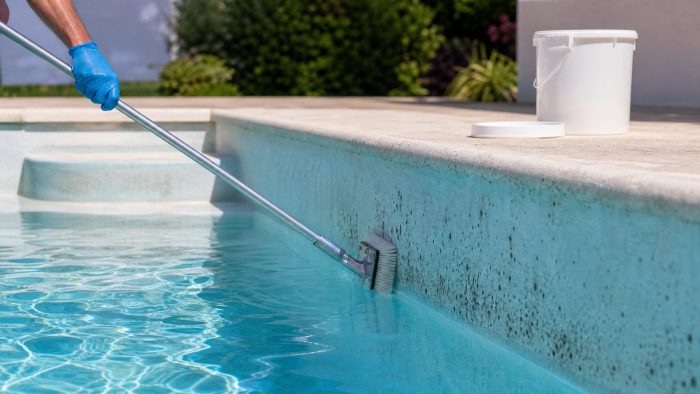
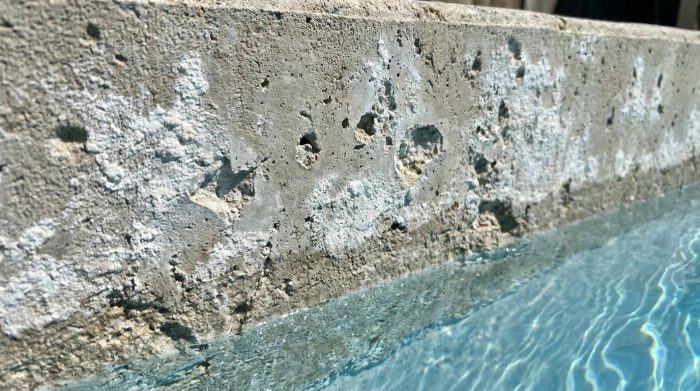
Surface etching and pitting — Run your hand along the pool wall below the waterline. If it feels rough or pitted where it was once smooth, that’s aggressive water at work. On plaster pools, you might see visible white or gray etching marks.
Foamy water — Soft water tends to foam more easily, especially when there’s any body oils, lotions, or organic material present. If you’re seeing persistent foam on the surface, low calcium hardness is one of the possible causes.
Corroded metal fittings — Check your ladder anchors, light bezels, and return jet fittings. Greenish staining or visible corrosion on stainless steel is a sign the water is pulling minerals from metal surfaces.
Eye and skin irritation — Soft water often has pH issues alongside the calcium problem, and the combination can cause more irritation than either issue alone.
Rapid pH swings — Low calcium hardness makes your water less stable overall. You may find yourself correcting pH and alkalinity more frequently than usual.
Why Fiberglass Pools Are Especially Vulnerable
If you have a fiberglass pool, pay close attention to this section. Fiberglass surfaces rely on a gel coat — a hard outer layer that gives the pool its smooth, glossy finish. Aggressive water (low calcium, often combined with low pH or low alkalinity) can cause the gel coat to blister, delaminate, or develop a chalky, faded appearance called “osmotic blistering.”
This type of damage isn’t cosmetic — it’s structural, and repairing it costs thousands of dollars. The fix for blistering is resurfacing, which means draining the pool and grinding down the affected area. Keeping your calcium hardness in the 150–250 ppm range for fiberglass pools is genuinely one of the best things you can do to protect your investment.
How to Raise Calcium Hardness in Your Pool
The fix is calcium chloride — sold as “calcium hardness increaser” or “calcium up” at any pool store. Don’t confuse it with calcium carbonate (that’s for limestone and some specialty applications) or calcium hypochlorite (that’s pool shock). The product you want is pure calcium chloride dihydrate, typically around 77% purity.
Here’s what to buy:
- Clorox Pool&Spa Calcium Hardness Increaser 5 lb — A reliable standard option, easy to find, dissolves cleanly.
- HTH Pool Care Calcium Hardness Up 4 lb — Another solid choice, slightly lower cost per pound on Amazon.
Step-by-Step: How to Add Calcium Chloride
Step 1: Test your current levels first.
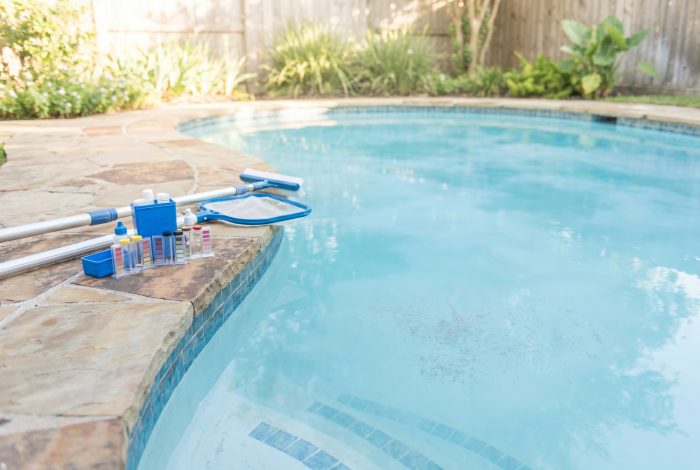
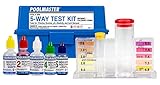
Use a good test kit before you add anything. You need to know your starting calcium hardness level to calculate the right dose. Strip-based tests are acceptable for a rough reading, but a drop-based kit gives you more accurate results.
- Taylor Technologies K-2006 Complete Test Kit — The gold standard for pool water testing. Tests calcium hardness, chlorine, pH, alkalinity, cyanuric acid, and more.
Step 2: Calculate how much calcium chloride you need.
The general formula: to raise calcium hardness by 10 ppm in a 10,000-gallon pool, you need approximately 1.25 pounds of calcium chloride.
So: lbs needed = (target ppm − current ppm) ÷ 10 × 1.25 × (pool gallons ÷ 10,000)
Example: Your pool holds 20,000 gallons. Your current calcium hardness is 120 ppm. You want to get to 250 ppm.
- Increase needed: 250 − 120 = 130 ppm
- 130 ÷ 10 = 13 increments of 10 ppm
- 13 × 1.25 = 16.25 lbs for 10,000 gallons
- For 20,000 gallons: 16.25 × 2 = 32.5 lbs
That’s a lot of product. Don’t add it all at once.
Step 3: Add in batches — don’t dump it all in.
Calcium chloride releases heat when it dissolves. Adding too much at once can cause localized cloudiness, and in extreme cases it can cause scaling on the pool surface where the concentrated chemical lands. Split large doses into two or three additions, spacing them 4–6 hours apart.
Step 4: Pre-dissolve in a bucket.
Fill a 5-gallon bucket about two-thirds full with pool water. Slowly add the calcium chloride to the bucket and stir. Don’t add water to the chemical — add the chemical to the water. The mixture will get warm — that’s normal. Let it cool slightly before adding to the pool.
Step 5: Add while the pump is running.
Pour the dissolved calcium mixture slowly around the perimeter of the pool, keeping the pump circulating to distribute it evenly. Avoid pouring it directly over steps, vinyl surfaces, or directly in front of a return jet where it’ll stay concentrated in one spot.
Step 6: Wait 24–48 hours before retesting.
Calcium chloride needs time to fully circulate and stabilize. Test again after a day or two, then decide if you need another round.
> Stop guessing with pool chemicals. Get exact calcium hardness dosing for your specific pool size with the Pool Chemical Calculator app — enter your pool volume and current reading, and it tells you exactly how many pounds to add. Works for chlorine, shock, pH, alkalinity, calcium, and more.
>
> Download the Pool Chemical Calculator app →
> Available for iPhone and Android.
Can You Raise Calcium Hardness Too Much?
Yes, and overcorrecting is also a problem. Calcium hardness above 400 ppm starts causing its own issues: scaling on the pool walls and floor, cloudy water, rough surfaces, and reduced efficiency in your filter. Scale on salt cell electrodes is a particularly expensive consequence — it reduces chlorine production and shortens the cell’s lifespan.
If you overshoot, the only real fix is dilution — partially draining the pool and refilling with fresh water. There’s no chemical that removes calcium from pool water.
This is why you should add calcium in stages and retest before going further.
How Often Should You Test Calcium Hardness?
For most pools, checking calcium hardness once a month is enough during swim season. If you’re in an area with naturally soft fill water (the Pacific Northwest, parts of the Northeast, much of the Southeast), you might need to check more frequently because refilling after evaporation gradually dilutes calcium levels.
When you open the pool in spring, calcium hardness should be one of your first tests — along with pH, alkalinity, and cyanuric acid. If you’re refilling after partial drainage, test immediately after.
A good rule: any time you add more than a few inches of fresh water, retest your calcium hardness within a day or two.
Calcium Hardness and the Langelier Saturation Index
If you’ve heard of the Langelier Saturation Index (LSI), calcium hardness is a key part of that calculation. The LSI is a formula that tells you whether your water is corrosive (negative LSI) or scale-forming (positive LSI). The target is an LSI between −0.3 and +0.3.
Low calcium hardness pushes your LSI negative — meaning corrosive. Even if your pH and alkalinity look fine individually, low calcium can drag the whole balance into corrosive territory. This is especially relevant for pools that run heated or have commercial-grade circulation.
If you’re seeing persistent surface damage despite otherwise normal chemistry, checking your LSI (not just individual parameters) often reveals the problem.
Frequently Asked Questions
What happens if pool calcium hardness is too low?
Low calcium hardness creates aggressive, corrosive water that pulls minerals from pool surfaces, plaster, grout, and metal fittings. Over time, this causes pitting, etching, surface deterioration, and corrosion of metal components. Fiberglass pools can develop gel coat blistering, which is expensive to repair.
What is the fastest way to raise calcium hardness in a pool?
Calcium chloride (sold as calcium hardness increaser) dissolves quickly and raises calcium hardness within hours. Pre-dissolve it in a bucket of pool water first, then add slowly around the perimeter with the pump running. You’ll see a stable reading after 24–48 hours of circulation.
How much calcium chloride do I need to raise hardness by 50 ppm?
For a 10,000-gallon pool, you need approximately 6.25 lbs to raise calcium hardness by 50 ppm. Multiply by your pool’s volume in 10,000-gallon increments. A 20,000-gallon pool needs about 12.5 lbs; a 30,000-gallon pool needs about 18.75 lbs. Add in two batches for doses above 10 lbs.
Does rain lower pool calcium hardness?
Yes. Heavy rainfall dilutes your pool water, which lowers calcium hardness along with other chemical levels. If your area had significant rainfall and you’re experiencing any symptoms of soft water (foaming, surface etching), test your calcium hardness and rebalance as needed.
Can low calcium hardness cause cloudy pool water?
Low calcium hardness by itself doesn’t typically cause cloudy water — cloudiness is more often a chlorine or pH issue. However, when soft water causes surface etching, the fine particles released can contribute to cloudiness. If you have cloudy water alongside low calcium, address the calcium first, then reassess.
As an Amazon Associate, Pool Chemical Calculator earns from qualifying purchases. Accurate readings make every chlorine, pH, alkalinity, calcium, and CYA dose safer. Raises calcium hardness to reduce corrosive water risk in plaster, concrete, and equipment. Useful for algae cleanup, cloudy water, high bather load, and weekly oxidation routines.Recommended pool supplies


Get exact pool chemical doses
Pool Chemical Calculator turns your test readings, pool volume, and target levels into exact treatment amounts for chlorine, pH, alkalinity, calcium, stabilizer, salt, and more.
Open the Pool Chemical Calculator app or download it from the App Store and Google Play.