
Pool Calcium Hardness Too High? Here’s How to Fix It Without Draining Your Pool
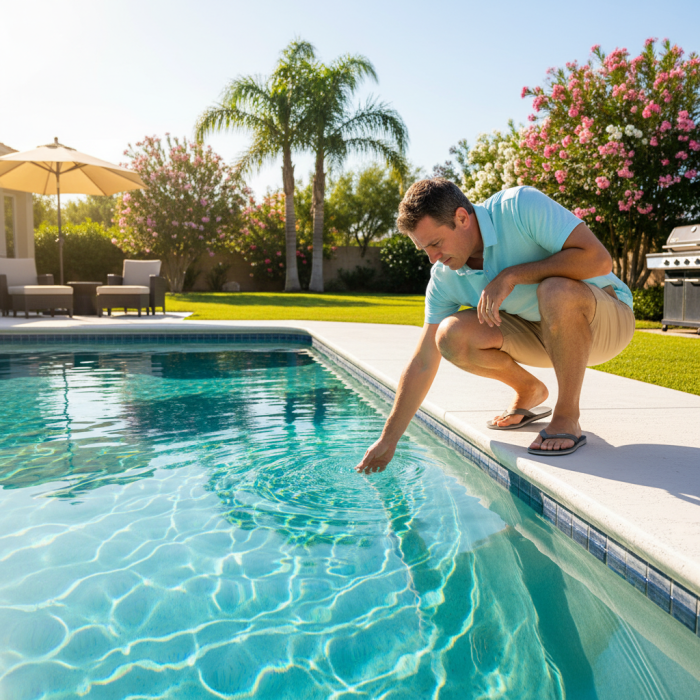
You tested your water, and now you’re staring at a calcium hardness reading that’s way above the recommended range. Maybe it’s 500 ppm. Maybe it’s 800 ppm. Either way, your pool calcium hardness is too high, and you’re wondering what happens next. Does high calcium actually damage your pool? Can you fix it without draining thousands of gallons? And how did this happen in the first place?
Quick answer
Pool Calcium Hardness Too High? Here’s How to Fix It Without Draining Your Pool: You tested your water, and now you’re staring at a calcium hardness reading that’s way above the recommended range. Maybe it’s 500 ppm. Maybe it’s 800 ppm. Either way, your pool calcium hardness is too high , and.
Good news: you’ve got options. Some are free, some cost a bit, and only one involves draining water. Let’s figure out which approach makes sense for your situation.
What Is Calcium Hardness (And Why Does It Matter)?
Calcium hardness measures the amount of dissolved calcium in your pool water. Think of it like the mineral content in your drinking water — some areas have “hard” water loaded with minerals, others have “soft” water with almost none.
For pools, the sweet spot is 200-400 ppm (parts per million). Some experts narrow that range to 220-350 ppm for plaster pools and 175-225 ppm for vinyl or fiberglass.
Here’s why that range matters:
Too low (under 150 ppm): Your water gets aggressive. It literally pulls calcium from wherever it can find it — your plaster walls, your grout, your tile. This causes etching, pitting, and expensive surface damage.
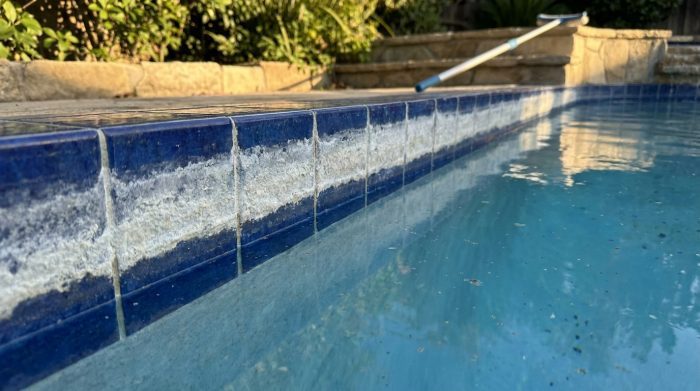
Too high (over 400 ppm): Calcium doesn’t stay dissolved. It precipitates out and deposits on everything — your tile, your filter, your heater, your salt cell. That white crusty scale? That’s calcium.
Your pool water is constantly trying to achieve balance. When calcium levels climb too high, the water becomes supersaturated and starts dumping excess calcium onto every surface it touches.
Signs Your Calcium Hardness Is Too High
Sometimes high calcium announces itself loudly. Other times it’s subtle. Watch for these warning signs:
Salt cells hate bad chemistry. Pool Chemical Calculator helps you keep pH, alkalinity, calcium hardness, and stabilizer in range so your salt system can make chlorine instead of scale. Works for any pool type.
Visible Scale Buildup
White, crusty deposits along your waterline are the most obvious symptom. This scale forms where water evaporates — on tiles, around skimmer openings, on ladder rails. It’s rough to the touch and difficult to remove once it hardens.
Cloudy Water That Won’t Clear
You’ve shocked the pool. You’ve run the filter 24/7. But the water stays hazy. High calcium combined with high pH creates calcium carbonate — tiny particles suspended throughout your water that make it look milky or dull.
Reduced Water Flow
Scale doesn’t just form where you can see it. It builds up inside your heater, your pipes, your pump impeller. If you’ve noticed reduced flow or your heater struggling to warm the pool, calcium deposits could be restricting water movement.
Salt Cell Problems
Got a saltwater pool? Your chlorine generator hates high calcium. Scale coats the cell plates, reducing chlorine production and eventually killing the cell entirely. A replacement cell costs $400-800. Preventing scale is cheaper.
What Causes High Calcium Hardness?
Understanding the cause helps you prevent future problems. Here are the usual suspects:
Your Fill Water
This is the #1 cause. If your tap water comes from a well or a municipal supply with hard water, every gallon you add brings more calcium. I’ve seen tap water test at 300+ ppm straight from the hose. Add evaporation (which removes water but leaves calcium behind), and levels climb fast.
Check your local water utility’s annual report. They’re required to publish hardness levels. Or just test your tap water with the same kit you use for your pool.
Calcium Hypochlorite Shock
Using cal-hypo shock? Every pound adds about 7 ppm of calcium hardness per 10,000 gallons. Shock your pool weekly all summer, and you’re adding significant calcium over time.
Switch to dichlor, liquid chlorine (sodium hypochlorite), or non-chlorine shock if calcium is a recurring problem. Liquid chlorine adds zero calcium. It’s bulkier to store but worth considering.
Plaster Pools in Acidic Water
If your pH runs low (under 7.2) consistently, acidic water dissolves calcium from your plaster surface. That calcium goes right back into your water. You’ve transferred calcium from your walls into solution — damaging your finish while raising your hardness.
Using Too Much Calcium Increaser
Oops. Maybe you misread your test, miscalculated the dose, or added product meant for a larger pool. It happens. Unlike chlorine, calcium doesn’t burn off or degrade. What goes in, stays in.
How to Lower Calcium Hardness: Your Options
Here’s the truth that pool store employees sometimes skip: there’s no chemical you can pour in to remove calcium. You can’t neutralize it like you neutralize acid with base. Calcium must physically leave your water.
That leaves you with three approaches:
Option 1: Partial Drain and Refill (The Direct Approach)
This is the most reliable method. Drain some high-calcium water, replace it with lower-calcium water, and your levels drop proportionally.
The math is simple:
- Drain 25% of your pool → calcium drops by roughly 25%
- Drain 50% of your pool → calcium drops by roughly 50%
If your pool holds 15,000 gallons and calcium tests at 600 ppm, draining and refilling 7,500 gallons (half the pool) with 100 ppm tap water should bring you to around 350 ppm.
How to do it:
1. Test both your pool water AND your tap water for calcium hardness
2. Calculate how much to drain using a pool calculator
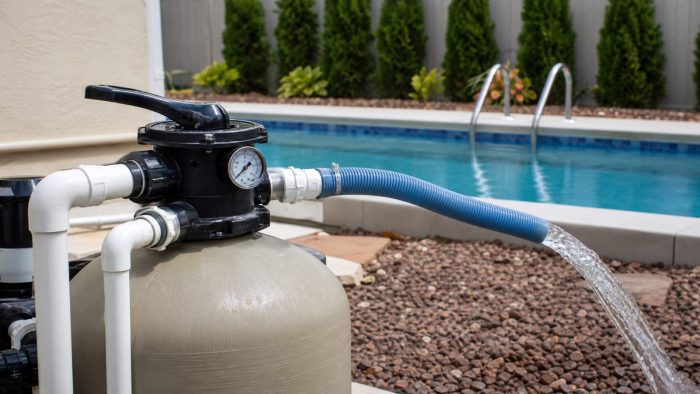
3. Set your multiport valve to “waste” (don’t backwash — you want to remove water, not circulate it)
4. Drain to your desired level (never drain plaster pools completely without professional guidance)
5. Refill slowly while monitoring levels
6. Rebalance all chemistry — pH, alkalinity, chlorine, stabilizer
Warning: If your tap water tests above 250 ppm, draining won’t help much. You’re replacing hard water with… hard water. Consider option 2 or 3.
Option 2: Use a Reverse Osmosis (RO) Mobile Service
These companies bring a truck-mounted RO system to your house and process your pool water on-site. The machine removes calcium, TDS, cyanuric acid, and other dissolved stuff, then returns purified water to your pool.
Pros:
- No draining (conserves water in drought-restricted areas)
- Removes multiple contaminants simultaneously
- Doesn’t disturb plaster pools
Cons:
- Costs $300-600 depending on pool size and contamination level
- Takes 12-24 hours for the process
- Not available everywhere
Search “mobile pool RO service” plus your city. It’s becoming more common, especially in Arizona, California, Texas, and Florida where water conservation matters.
Option 3: Use a Flocculant (Temporary Visual Fix)
A flocculant like Super Blue Water Clarifier or similar product binds to suspended particles and sinks them to the bottom for vacuuming.
Important caveat: This helps with cloudiness caused by calcium carbonate precipitation. It doesn’t actually lower your calcium hardness reading. The dissolved calcium remains. You’re removing precipitated calcium particles, not dissolved calcium ions.
Still useful? Yes. If your water looks milky, a flocculant + vacuum to waste combo clears it up. But you’ll still need to address the underlying hardness level with option 1 or 2.
Preventing High Calcium in the Future
Once you’ve got calcium under control, keep it there:
Know Your Source Water
Test your tap water every year. Hardness can change seasonally or when utilities switch sources. A basic test kit like the Taylor K-1766 Hardness Test Kit works great.
If your tap runs over 250 ppm, consider adding a hose-end filter or using softened water for top-offs.
Ditch the Cal-Hypo
Switch to liquid chlorine for shocking. It’s 12.5% sodium hypochlorite — same active ingredient as bleach, just stronger. Zero calcium added. You can buy it at pool stores in 2.5-gallon jugs or find it at hardware stores as “pool shock.”
Maintain Balanced Water
The saturation index matters here. When pH and alkalinity climb too high alongside elevated calcium, you get scale formation even if individual readings seem acceptable. Keep pH at 7.4-7.6 and alkalinity at 80-120 ppm to minimize precipitation.
Use a Sequestering Agent
Products containing phosphonic acid “sequester” calcium — they bind to calcium ions and keep them from forming visible scale. This doesn’t lower your hardness reading, but it prevents the worst symptoms while you plan a longer-term fix.
Natural Chemistry Pool Perfect + PHOSfree combines scale prevention with phosphate removal. Add weekly during high season.
FAQ
Can I use muriatic acid to lower calcium hardness?
No. This is a common misconception. Muriatic acid lowers pH and alkalinity, not calcium hardness. Adding acid when calcium is high can actually create other problems — acidic, scale-saturated water damages equipment faster. Don’t do it.
How often should I test for calcium hardness?
Monthly during swim season is enough for most pools. Calcium changes slowly unless you’re adding water frequently. Test more often if you’ve recently had problems or your source water is very hard.
Will high calcium hurt swimmers?
Not directly. Calcium doesn’t irritate skin or eyes like imbalanced pH or chlorine. But cloudy water from calcium precipitation makes it harder to see swimmers in distress and generally indicates other chemistry problems. And nobody wants to swim in hazy water.
My pool store says I need to drain immediately. Is that true?
Probably not “immediately.” High calcium causes gradual damage, not instant destruction. A reading of 500-600 ppm won’t ruin your pool overnight. You have time to plan a proper drain, wait for cooler weather, or schedule an RO service. Don’t panic, but don’t ignore it for months either.
Can I use a water softener to fill my pool?
Technically yes, but it’s not ideal. Softeners replace calcium ions with sodium ions. This solves the hardness problem but raises your salt level. For standard chlorine pools, too much salt causes its own issues. For saltwater pools, you might overshoot your target salt range. Test and calculate before adding softened water.
Get Your Calcium Levels Right
Guessing at drain amounts and chemical doses wastes time and money. Use the free Pool Chemical Calculator app to figure out exactly how much water to drain based on your current calcium reading, your target level, and your source water hardness. Punch in your numbers, get your answer, and fix the problem the first time.
As an Amazon Associate, Pool Chemical Calculator earns from qualifying purchases. Raises free chlorine quickly without adding stabilizer, which is useful when CYA is already high. Accurate readings make every chlorine, pH, alkalinity, calcium, and CYA dose safer. Lowers high pH and helps bring alkalinity down when used carefully.Recommended pool supplies


Get exact pool chemical doses
Pool Chemical Calculator turns your test readings, pool volume, and target levels into exact treatment amounts for chlorine, pH, alkalinity, calcium, stabilizer, salt, and more.
Open the Pool Chemical Calculator app or download it from the App Store and Google Play.