
Pool Alkalinity Low But pH High: Why It Happens and How to Fix It
You test your pool water expecting one problem, and you find two — your alkalinity sits below 80 ppm while your pH is reading 7.8 or higher. That combination seems backwards. Isn’t alkalinity supposed to support stable pH? If your pool alkalinity is low but pH is high, you’re dealing with a chemistry mismatch that’s more common than most pool owners realize. And if you don’t fix both numbers — in the right order — you’ll spend the whole season chasing your tail.
Quick answer
Pool Alkalinity Low But pH High: Why It Happens and How to Fix It: You test your pool water expecting one problem, and you find two — your alkalinity sits below 80 ppm while your pH is reading 7.8 or higher. That combination seems backwards. Isn’t alkalinity supposed to support stable.
This guide breaks down exactly why your pool develops low alkalinity alongside high pH, what damage it causes if left alone, and the step-by-step correction process that actually works.
Why Alkalinity and pH Are Different Things
This is the root of the confusion. People treat alkalinity and pH like they’re measuring the same thing. They’re not.
Total alkalinity (TA) measures the concentration of alkaline compounds dissolved in your water — primarily bicarbonates and carbonates. It’s expressed in ppm, and the target range is 80–120 ppm. TA acts as a chemical buffer, absorbing changes before they affect your pH. When TA is high, it takes a lot of acid or base to move your pH. When TA is low, pH becomes unstable and reactive.
pH measures the actual acidity or basicity of your water right now, on a scale of 0–14. Pool water should sit at 7.4–7.6. At that range, chlorine works efficiently, the water doesn’t irritate skin and eyes, and your equipment isn’t corroding or scaling.
Here’s the key insight: pH can be high even when alkalinity is low. That’s because whatever is causing the high pH can be stronger than the buffer that’s supposed to resist it. With a depleted TA, even a modest alkaline input sends your pH climbing fast and keeps it there.
5 Causes of Low Alkalinity With High pH
One of these is almost certainly responsible for your situation.
Cause #1: Sodium Carbonate (Soda Ash) Added to Raise pH
Soda ash is the standard chemical for raising pool pH. The problem is that it raises pH dramatically while adding comparatively less to total alkalinity. A single 1-pound dose can push pH from 7.2 to 7.8 in a 10,000-gallon pool while only nudging TA up by 10–15 ppm.
If someone added soda ash to your pool — or you added it yourself — to correct low pH at some point, you may have overcorrected the pH without meaningfully building up your alkalinity. The result: pH lands in the high zone, TA stays depleted.
Cause #2: Cal-Hypo Shock or Liquid Chlorine (Sodium Hypochlorite)
Calcium hypochlorite (cal-hypo) shock has a pH around 11–12. Liquid chlorine (sodium hypochlorite) runs pH 13. Both are highly alkaline. Regular use of either product raises your pool’s pH steadily over time.
The twist: both products also add very little to total alkalinity because they don’t contribute significant bicarbonates. The alkaline input they provide gets processed or diluted, but the pH elevation lingers — especially in a pool with a weak TA buffer that can’t resist it.
Cause #3: Aeration or Water Features
This one surprises people. Aerators, waterfalls, fountains, and aggressive return jets cause dissolved CO2 to escape the water. CO2 is acidic. When it leaves, pH rises — sometimes significantly.
Here’s what makes this particularly relevant: aeration has essentially no effect on total alkalinity. It only affects the CO2/carbonate balance. So a pool with active water features can show pH of 7.9+ while alkalinity sits at 60 ppm — and the water features are entirely responsible for the gap.
Saltwater pools with electrolytic chlorine generators (ECGs) experience a version of this too. The electrolysis process generates hydroxide ions at the cathode, raising pH without meaningfully raising TA.
Cause #4: Acid Rain or Heavy Rain — Then Rebound
This one’s counterintuitive. Heavy rain is slightly acidic (pH 5.0–5.5), which drives your pool’s pH down and dilutes alkalinity. Some pool owners respond by adding sodium carbonate or other alkaline products to recover pH. If they add too much, pH overshoots into the high range while TA remains diluted from the rain.
The pattern: rain dilutes TA → pH crashes → overcorrection with soda ash → pH now high, TA still low.
Cause #5: Low Starting Alkalinity That Was Never Addressed
Sometimes the simplest explanation is the right one. If your pool has been running with low alkalinity for weeks or months, you’ve essentially been operating without a pH buffer. The slightest alkaline input — fill water, body fluids, chlorine products — nudges pH up and it stays up because there’s nothing to resist it.
Municipal fill water from certain areas also runs pH 7.8–8.2. If your pool’s TA is too low to buffer it, that incoming water sets the pH tone and you’re stuck with it.
Why You Must Fix Both — and in the Right Order
Here’s where a lot of pool owners make the problem worse. They test, see high pH, and reach for muriatic acid or sodium bisulfate. That brings pH down. Then they check alkalinity, see it’s low, and add sodium bicarbonate. The bicarb brings alkalinity up — but also pushes pH back up. Back to muriatic acid. And so on.
That loop is frustrating and expensive. The reason it happens: you’re treating the symptom (high pH) before fixing the underlying instability (low TA).
The correct sequence is:
1. Raise total alkalinity first with sodium bicarbonate
2. Allow pH to stabilize (it may drop slightly when TA rises, which is expected)
3. Then fine-tune pH downward with acid if it’s still too high
Once your TA is in the 80–120 ppm range, your pH buffer is restored. From that point, a small, precise dose of acid gets pH to 7.4–7.6 and it stays there.
Stop guessing with pool chemicals. Get exact measurements for your pool size with the Pool Chemical Calculator app. Works for chlorine, shock, pH adjusters, alkalinity, calcium, and more. Free for iOS and Android.
Step-by-Step Fix: Low Alkalinity and High pH
Step 1 — Test Accurately
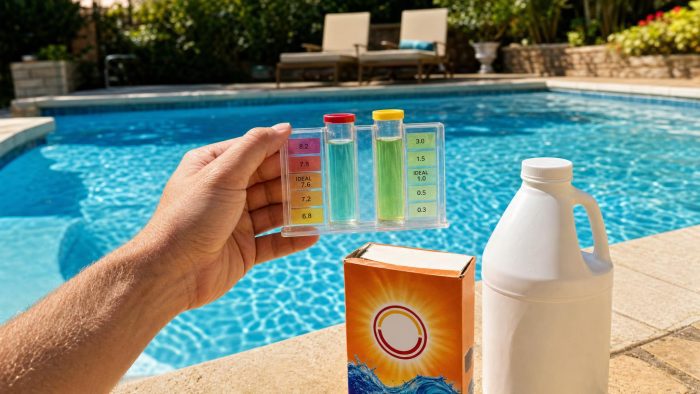
Before adding anything, get a solid baseline. Use a reliable liquid test kit (Taylor K-2006 is the gold standard) or quality test strips. You need confirmed numbers for:
- Total alkalinity (target: 80–120 ppm)
- pH (target: 7.4–7.6)
- Cyanuric acid (CYA) — levels above 80 ppm inflate your TA reading; factor this in
Step 2 — Calculate Your Sodium Bicarbonate Dose
Sodium bicarbonate (baking soda) raises total alkalinity without dramatically affecting pH. It’s safe, inexpensive, and predictable.
General dosing guideline:
- 1.5 lbs of sodium bicarbonate per 10,000 gallons raises TA by approximately 10 ppm
- If your TA is at 60 ppm and you want 100 ppm, you need to raise it by 40 ppm
- For a 20,000-gallon pool: 40 ppm ÷ 10 ppm × 1.5 lbs × 2 = 12 lbs of baking soda
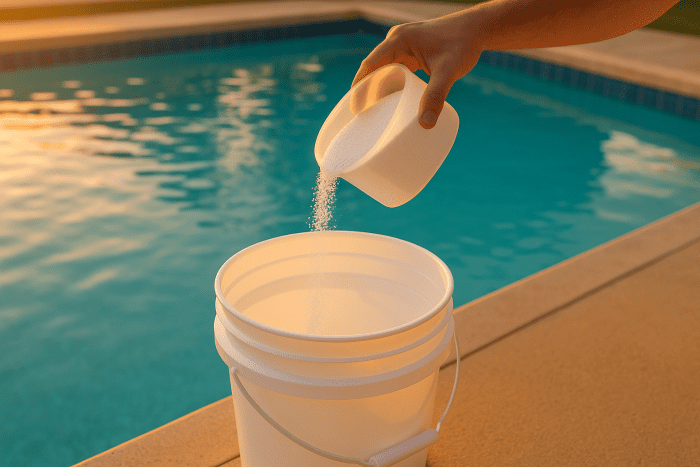
Add sodium bicarbonate by broadcasting it across the surface of the pool with the pump running. Do it in increments — add half your dose, wait 2–4 hours, retest, then add the remainder if needed.
Step 3 — Retest After 4–6 Hours
Give the sodium bicarbonate time to fully dissolve and circulate. Retest alkalinity and pH. In many cases, raising TA with bicarb naturally brings pH down from the high range slightly (toward 7.6–7.8) because the buffering chemistry shifts. You may need little or no acid at this point.
Step 4 — Lower pH If Still Elevated
If pH is still above 7.6 after alkalinity is corrected:
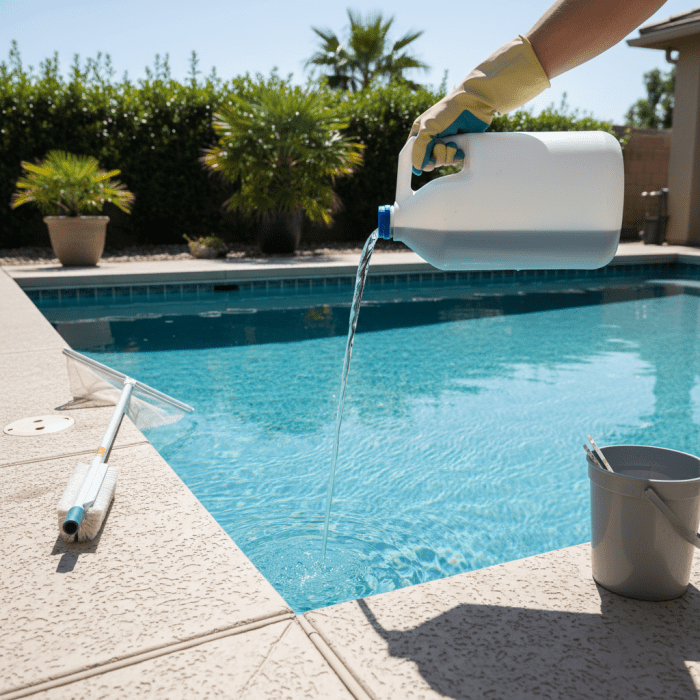
Option A — Muriatic acid (hydrochloric acid): Fastest-acting. Dilute in a bucket of pool water first. Add slowly near a return jet with the pump running. Avoid pouring near pool walls or fixtures.
Option B — Sodium bisulfate (dry acid): Safer to handle, slower to work. Broadcast across the deep end.
Approximate dosing (muriatic acid, 31.45%):
- 6 fl oz per 10,000 gallons lowers pH by approximately 0.2
- If pH is at 7.9 and you need 7.5, that’s a 0.4 drop: roughly 12 fl oz for a 10,000-gallon pool
Add acid incrementally — half your calculated dose, wait 1 hour, retest. Overshooting pH downward with low TA depleted is what started this problem in the first place.
Step 5 — Retest and Confirm
Wait 4–6 hours after the acid dose, then test again. Target:
- Total alkalinity: 80–120 ppm
- pH: 7.4–7.6
If both numbers land in range, you’re done. Run your pump for 8–12 hours to ensure even distribution.
Step 6 — Address the Root Cause
If cal-hypo shock or liquid chlorine was driving your pH high, consider switching to trichlor tablets or dichlor granular for routine chlorination. These are acidic and will help keep pH from climbing again.
If aeration is the culprit (waterfall, jets, SWG), reduce aeration time or add a small dose of CO2 via an injection system — a solution used by commercial pool operators specifically because it lowers pH without affecting TA.
Quick Reference: Ideal Pool Chemical Ranges
| Parameter | Low Range | Target | High Range |
|—|—|—|—|
| Total Alkalinity | Below 80 ppm | 80–120 ppm | Above 120 ppm |
| pH | Below 7.2 | 7.4–7.6 | Above 7.8 |
| Cyanuric Acid | Below 30 ppm | 30–50 ppm | Above 80 ppm |
| Calcium Hardness | Below 200 ppm | 200–400 ppm | Above 400 ppm |
| Free Chlorine | Below 1 ppm | 1–3 ppm | Above 5 ppm |
What Happens If You Ignore Low TA With High pH
Leaving this imbalance unaddressed causes real damage over time:
Chlorine loses effectiveness. At pH above 7.8, only about 15% of your chlorine is active (hypochlorous acid). At 8.0, it drops to 5%. You’re wasting chemicals and swimming in undertreated water.
Scale forms on surfaces and equipment. High pH accelerates calcium carbonate precipitation. You’ll see white scale on tiles, pool walls, the heater heat exchanger, and salt cell. Equipment life drops significantly.
pH bounces wildly. With low TA as a buffer, your pH will swing dramatically with any chemical addition, rain, or heavy swim load. You’ll test one day and see 7.3; the next day it’s 8.1. The instability is exhausting to manage.
Swimmer discomfort. pH above 7.8 causes eye and skin irritation. Swimmers complain. Goggles fog faster. It’s unpleasant.
Frequently Asked Questions
Can I just add acid to lower pH and ignore the low alkalinity?
Short answer: no. Adding acid when alkalinity is already low will drop your pH but also potentially crash it into dangerously acidic territory. And without TA as a buffer, pH won’t stay where you put it. Fix TA first.
How long does it take to fix low alkalinity with high pH?
With the correct sequence — sodium bicarbonate first, acid second — you can have both parameters in range within 24–48 hours. Rushing by adding everything at once typically extends the correction window to several days.
Will sodium bicarbonate (baking soda) raise my pH?
Sodium bicarbonate has a pH of about 8.3, so it does slightly raise pH when added — typically by 0.1–0.2 in a full pool. That’s why it’s so useful here: you raise TA and give pH a small upward nudge, then a small acid dose brings it to exactly 7.4–7.6.
My pool water looks fine. Do I still need to fix these numbers?
Yes. Crystal clear water doesn’t mean balanced water. You can have perfect clarity with pH at 8.0 and TA at 50 ppm. The damage is happening to your chlorine’s effectiveness, your equipment, and your surfaces — it just isn’t visible yet.
How often should I test alkalinity?
At minimum, test weekly during swim season. If you have an SWG, water features, or use liquid chlorine, test every 3–4 days since these factors move pH faster than other systems.
Ready to get your numbers dialed in? The Pool Chemical Calculator takes your current readings and tells you exactly how much sodium bicarbonate and acid to add for your pool’s size. No charts, no guesswork — just the dose.
Get the Pool Chemical Calculator — Free
As an Amazon Associate, Pool Chemical Calculator earns from qualifying purchases. Raises total alkalinity so pH is less likely to bounce around after treatment. Lowers high pH and helps bring alkalinity down when used carefully. Raises free chlorine quickly without adding stabilizer, which is useful when CYA is already high.Recommended pool supplies


Get exact pool chemical doses
Pool Chemical Calculator turns your test readings, pool volume, and target levels into exact treatment amounts for chlorine, pH, alkalinity, calcium, stabilizer, salt, and more.
Open the Pool Chemical Calculator app or download it from the App Store and Google Play.