
Pool Alkalinity High But pH Low: Why This Happens and How to Fix It
You’ve just tested your pool water and the numbers don’t make sense. Your alkalinity reads 180 ppm — way too high — but your pH sits at 7.0 or lower. Wait, isn’t alkalinity supposed to raise pH? If you’re scratching your head because your pool alkalinity is high but pH is low, you’re not alone. This confusing chemistry puzzle trips up thousands of pool owners every season. And yes, there’s a logical explanation. Better yet, there’s a straightforward fix.
Quick answer
Pool Alkalinity High But pH Low: Why This Happens and How to Fix It: You’ve just tested your pool water and the numbers don’t make sense. Your alkalinity reads 180 ppm — way too high — but your pH sits at 7.0 or lower. Wait, isn’t alkalinity supposed to raise pH? If you’re scratching.
Here’s the thing: alkalinity and pH are related, but they’re not the same measurement. They can absolutely move in opposite directions under the right conditions. Let’s break down exactly why this happens and walk through the step-by-step process to get both numbers back where they belong.
Understanding the Alkalinity-pH Relationship
Before we fix the problem, let’s understand what we’re actually measuring. Think of it like blood pressure — you’ve got two numbers that are connected but measure different things.
What Total Alkalinity Actually Measures
Total alkalinity (TA) measures the concentration of alkaline substances dissolved in your water — primarily bicarbonates, carbonates, and hydroxides. It’s measured in parts per million (ppm), and the ideal range sits between 80-120 ppm.
Here’s the key concept: alkalinity acts as a buffer for pH. It’s like the shock absorbers on your car. When something tries to push your pH up or down, alkalinity absorbs that impact and keeps pH stable.
What pH Actually Measures
pH measures how acidic or basic your water is right now, on a scale from 0 to 14. For pools, you want 7.4-7.6 — slightly basic, easy on the eyes, and perfect for chlorine effectiveness.
Why They Usually Move Together (But Not Always)
Normally, when alkalinity rises, pH tends to follow. Add an alkaline substance, and both numbers climb. But your pool isn’t a chemistry textbook. Real-world conditions create situations where these two measurements go in completely different directions.
The 4 Main Causes of High Alkalinity With Low pH
Your pool didn’t develop this imbalance randomly. One of these culprits is almost certainly responsible.
Cause #1: Using Dichlor or Trichlor Chlorine
This is the most common cause by far. Stabilized chlorine products — dichlor (granular) and trichlor (tablets) — are acidic. Very acidic. Trichlor tablets have a pH around 2.8-3.0. That’s more acidic than vinegar.
Here’s what happens: You add trichlor tablets to your chlorinator. They dissolve and sanitize your water. But they also dump acid into your pool continuously. Over weeks, your pH drops steadily.
Meanwhile, your alkalinity might stay high or even climb because of your water source, calcium buildup, or other factors. The result? High alkalinity, low pH, and a very confused pool owner.
Cause #2: Acid Rain or Heavy Rainfall
Rainwater is naturally acidic — typically pH 5.0-5.5. A heavy storm can dump thousands of gallons of slightly acidic water into your pool over a few hours.
This rainwater drives down your pH. But here’s the catch: rain doesn’t significantly affect alkalinity because rainwater contains almost no dissolved minerals. Your alkalinity stays put while your pH takes a nosedive.
If you live in an area with industrial pollution, acid rain can be even more pronounced. We’ve seen pools drop from pH 7.4 to 6.8 after a single thunderstorm.
Cause #3: High Cyanuric Acid Levels
Cyanuric acid (CYA) — the stabilizer that protects chlorine from sunlight — creates a sneaky problem. When CYA levels climb above 50-80 ppm, it interferes with your alkalinity test readings.
Standard alkalinity tests actually measure CYA as part of total alkalinity. So if your CYA is 100+ ppm, your “true” alkalinity might be 30-50 ppm lower than your test shows. Your pH responds to the actual alkalinity, not the inflated test number.
This means your alkalinity test reads 160 ppm, but your effective alkalinity is only 110 ppm. That’s not enough buffer to keep pH stable, so pH drifts low.
Cause #4: Fresh Fill With Mineral-Heavy Water
Did you recently fill or top off your pool? Some municipal water sources and wells contain high levels of bicarbonates but also dissolved CO2. The bicarbonates raise your alkalinity reading immediately. But dissolved CO2 is acidic, initially suppressing pH.
Usually, the CO2 outgasses over 24-48 hours and pH rises naturally. But if you test during that window, you’ll see high alkalinity with surprisingly low pH.
Dealing with high alkalinity and low pH? The Pool Chemical Calculator gives you step-by-step treatment plans based on your specific readings. Know exactly what to add and how much—no trial and error.
How to Fix High Alkalinity and Low pH (Step by Step)
Here’s the tricky part: you need to lower alkalinity while raising pH. Normally, chemicals affect both numbers in the same direction. But there’s a technique that lets you target alkalinity specifically.
Step 1: Test Your Water Accurately
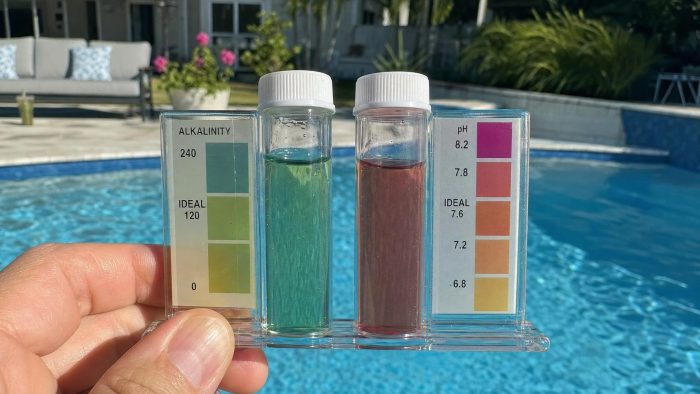
Before adjusting anything, get accurate numbers. Cheap test strips won’t cut it for this situation. You need a good liquid test kit like the Taylor K-2006 Complete Test Kit. It measures alkalinity, pH, chlorine, CYA, and calcium hardness with lab-grade accuracy.
Write down your current readings:
- Total Alkalinity: _____ ppm
- pH: _____
- Cyanuric Acid: _____ ppm
Step 2: Calculate Your Alkalinity Reduction
Determine how much you need to lower alkalinity. If your TA reads 180 ppm and you want 100 ppm, you need to drop 80 ppm.
For a 10,000-gallon pool, lowering alkalinity by 10 ppm requires approximately 12 oz of muriatic acid. So for an 80 ppm drop, you’d need roughly 96 oz (about 0.75 gallons) of muriatic acid.
Important: Never add more than 1 quart of muriatic acid at a time. This process happens in stages over several days.
Step 3: Use the “Acid Column” Technique
This is the secret to lowering alkalinity without crashing pH permanently. Standard acid addition affects both TA and pH. But concentrated acid addition in one spot affects alkalinity more than pH.
Here’s how it works:
1. Turn off your pump and wait 15 minutes for water to become still
2. Choose a deep spot in your pool (at least 4 feet)
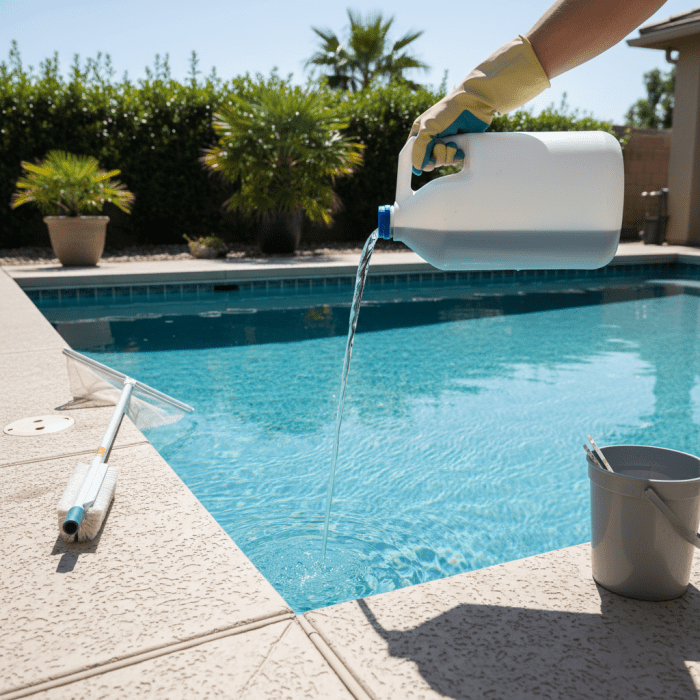
3. Slowly pour muriatic acid in a tight column straight down — don’t spread it around
4. Let it sit for 30 minutes without circulation
5. Turn the pump back on and let it run for 2 hours
6. Retest your water
The acid sinks and concentrates at the bottom, reacting aggressively with alkalinity in that zone. When you circulate the water afterward, the acid disperses but the alkalinity is already neutralized.
Step 4: Aerate to Raise pH Without Raising Alkalinity
After each acid treatment, your pH will be low. Instead of adding pH increaser (which raises alkalinity too), use aeration.
Aeration adds oxygen and releases dissolved CO2. This raises pH naturally without affecting alkalinity. You can aerate by:
- Running water features (fountains, waterfalls, deck jets)
- Pointing return jets upward to create surface agitation
- Using an air compressor with a hose in the pool
- Running your spa jets with the spa-pool connection open
Aggressive aeration can raise pH by 0.3-0.5 points over 24-48 hours. Keep aerating until pH reaches 7.4-7.6.
Step 5: Repeat Until Balanced
This process usually takes 3-5 cycles over a week or more. Test daily, add acid to lower alkalinity, then aerate to recover pH. Each cycle brings you closer to balanced water.
Target numbers:
- Total Alkalinity: 80-120 ppm
- pH: 7.4-7.6
Step 6: Address the Root Cause
Once balanced, prevent recurrence:
- If using trichlor tablets: Switch to liquid chlorine or add borax periodically to counteract acidity
- If CYA is high: Partial drain and refill is the only practical solution
- If it’s rainwater: Use a quality pool cover during storms and test after heavy rain
Preventing This Imbalance in the Future
The best fix is prevention. Here’s how to keep alkalinity and pH playing nice together.
Switch Your Chlorine Source
Liquid chlorine (sodium hypochlorite) has a high pH around 13, but it doesn’t significantly affect alkalinity. Using liquid chlorine instead of trichlor tablets eliminates the constant acid drip that causes this imbalance.
Salt chlorine generators are another option — they produce chlorine on-site without adding acid to your water.
Test Weekly, Not Monthly
Pool chemistry shifts constantly. Temperature changes, bather load, rainfall, and debris all affect your water. Testing weekly catches drift before it becomes a major correction project.
Maintain Proper CYA Levels
Keep cyanuric acid between 30-50 ppm for outdoor pools. Higher levels skew your alkalinity readings and reduce chlorine effectiveness. The only way to lower CYA is dilution — drain some water and refill with fresh.
Use a Quality Digital Tester for Convenience
If liquid testing feels tedious, consider a digital photometer like the LaMotte ColorQ Pro 7. It takes accurate readings in seconds, making weekly testing almost effortless.
When to Call a Pool Professional
Most alkalinity/pH imbalances are DIY-fixable. But consider professional help if:
- Your pool is plaster and pH has been below 7.0 for weeks (acid damage risk)
- You’ve completed 5+ acid cycles with no improvement
- Your CYA level exceeds 100 ppm
- You’re dealing with simultaneous metal staining or scaling issues
A pool service can drain, dilute, and rebalance faster than the chemical approach alone.
FAQ
Can I just add baking soda to raise pH?
No — baking soda (sodium bicarbonate) raises alkalinity, not pH. Adding it would make your high alkalinity problem worse. If you only need to raise pH, use soda ash (sodium carbonate). But in your situation, aeration is the better choice because it raises pH without touching alkalinity.
How long does the acid column technique take to work?
Each cycle takes about 24 hours — time for acid addition, settling, circulation, and aeration. Plan on 3-7 days total to fully correct a significant imbalance. Patience pays off here. Rushing leads to overshooting.
Will this imbalance damage my pool?
Yes, if left untreated. Low pH water is corrosive. It etches plaster, damages vinyl liners, corrodes metal fixtures, and irritates swimmers’ eyes and skin. High alkalinity alone isn’t as immediately damaging, but the combination accelerates problems. Fix it within 1-2 weeks.
My test strips show different numbers than my liquid kit. Which is right?
Trust the liquid kit. Test strips lose accuracy quickly with heat and humidity exposure, and they’re less precise by design. For troubleshooting weird chemistry situations like this, liquid kits or digital testers are essential.
Is there a chemical that lowers alkalinity but raises pH?
No single chemical does this. That’s why we use the two-step approach: acid lowers alkalinity (and temporarily pH), then aeration raises pH back up without affecting alkalinity. It’s the only reliable method.
Get Your Pool Chemistry Dialed In
Fixing high alkalinity with low pH takes a bit of patience, but the process is straightforward once you understand what’s happening. Test accurately, add acid in stages using the column technique, and aerate to recover pH.
Need help calculating exactly how much acid to add for your pool size? Head over to Pool Chemical Calculator and let us crunch the numbers for you. Just enter your current readings and pool volume — we’ll tell you exactly what to add and how much.
As an Amazon Associate, Pool Chemical Calculator earns from qualifying purchases. Raises low pH to protect swimmers, plaster, liners, heaters, and metal equipment. Lowers high pH and helps bring alkalinity down when used carefully. Raises free chlorine quickly without adding stabilizer, which is useful when CYA is already high.Recommended pool supplies


Get exact pool chemical doses
Pool Chemical Calculator turns your test readings, pool volume, and target levels into exact treatment amounts for chlorine, pH, alkalinity, calcium, stabilizer, salt, and more.
Open the Pool Chemical Calculator app or download it from the App Store and Google Play.