
Pool Cover Water Level Too High? Here’s How to Calculate the Weight and Fix It Fast
Quick answer
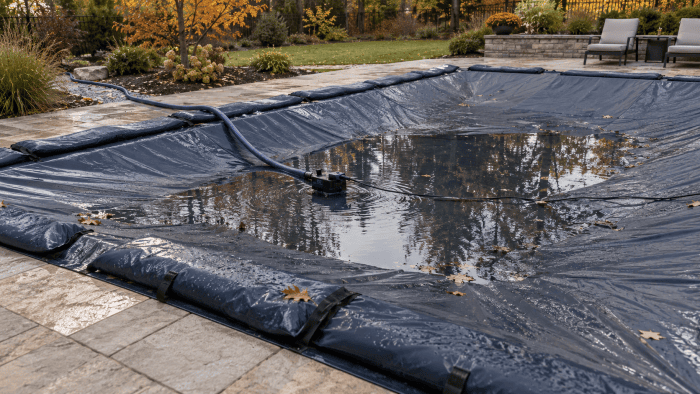
If pool cover water is too high, remove it once standing water reaches about 1 to 2 inches on a solid winter cover, any obvious pooling on an automatic cover, or enough sag to pull a safety cover well below the deck. Use an automatic cover pump at the lowest safe point, discharge water away from the pool and equipment pad, clear debris from the intake, and keep the actual pool water high enough to support the cover from below. Do not walk on a loaded cover; a few inches of water can weigh several thousand pounds.
Quick answer
Pool Cover Water Level Too High? Here's How to Calculate the Weight and Fix It Fast: Quick answer If pool cover water is too high, remove it once standing water reaches about 1 to 2 inches on a solid winter cover, any obvious pooling on an automatic cover, or enough sag to pull a safety cover well.
You walk out to check on your covered pool after a few days of rain, and your stomach drops. The cover looks like a sad, sagging hammock filled with murky water. Your pool cover water level is too high, and you’re wondering if the whole thing is about to tear or collapse into the pool.
Take a breath. This is fixable. But here’s what most pool advice misses: knowing how much water is actually sitting on your cover matters. A couple inches of rainwater on a 16×32 cover weighs nearly 2,000 pounds. That’s a small car sitting on your pool cover.
Let’s figure out exactly what you’re dealing with and get that water off before it causes real damage.
What We Analyzed: Pool Cover Water Weight & Pump Time Calculator
Most articles tell you “remove water from your pool cover” without helping you understand the urgency. So we built a calculation table that shows you three things:
- Total water volume on your cover (in gallons)
- Total weight pressing down on your cover (in pounds)
- Estimated pump time to remove it all
The Math Behind It
Here’s how we calculate each value:
- Volume (gallons) = Length (ft) × Width (ft) × Water Depth (inches) ÷ 12 × 7.48
- Weight (lbs) = Volume (gallons) × 8.34
- Pump Time (hours) = Volume (gallons) ÷ Pump Flow Rate (GPH)
We ran these calculations for common pool sizes with varying water depths. The results might surprise you.
Calculated Scenarios: Water Weight by Pool Size and Depth
| Pool Size | Water Depth | Total Gallons | Total Weight | Pump Time (850 GPH) | Pump Time (1800 GPH) |
|———–|————-|—————|————–|———————|———————-|
| 12′ round (above-ground) | 2 inches | 141 gallons | 1,176 lbs | 10 minutes | 5 minutes |
| 16′ × 32′ rectangle | 2 inches | 639 gallons | 5,329 lbs | 45 minutes | 21 minutes |
| 16′ × 32′ rectangle | 4 inches | 1,278 gallons | 10,658 lbs | 1.5 hours | 43 minutes |
| 18′ × 36′ rectangle | 3 inches | 1,213 gallons | 10,116 lbs | 1.4 hours | 40 minutes |
| 20′ × 40′ rectangle | 4 inches | 1,995 gallons | 16,638 lbs | 2.3 hours | 1.1 hours |
| 20′ × 40′ rectangle | 6 inches | 2,992 gallons | 24,953 lbs | 3.5 hours | 1.7 hours |
Methodology: These figures assume a uniform water depth across the cover surface. We used the standard water weight of 8.34 lbs per gallon. Pump times represent theoretical maximums and don’t account for debris clogs, hose friction, pump elevation, or efficiency loss.
Limitations: Real-world sagging creates uneven water depth—the center holds more than the edges. Your actual weight may concentrate in a smaller area, increasing stress. Pump times will be longer if your pump is older, the hose kinked, or debris clogs the intake.
Why This Matters
Look at that 20′ × 40′ pool with 6 inches of water. That’s nearly 25,000 pounds—about as much as a loaded moving truck—concentrated on your pool cover. Most safety covers are rated for 400+ pounds per square foot at the anchor points, but that weight isn’t distributed evenly. It’s pulling hardest at the center, stretching the material and straining your anchors.
How Much Water Is Too Much? Real Thresholds by Cover Type
“Too much water” isn’t the same for every cover. Here’s a breakdown by type:
Solid Winter Covers
These have zero drainage. Every drop of rain stays on top.
- Action threshold: 1-2 inches of standing water
- Danger zone: 4+ inches
- What fails first: The cover material stretches, water bags (if used) shift, and the cover can slip into the pool—dumping all that dirty water into your clean water
Mesh Safety Covers
These drain slowly, but “slowly” isn’t always enough during heavy rain.
- Action threshold: Water pooling faster than it drains
- Danger zone: Visible sagging more than 12 inches below the pool edge
- What fails first: Spring anchors can pull out of the deck, especially in older concrete
Automatic Covers
These expensive covers are also the most vulnerable to water weight damage.
- Action threshold: Any visible standing water
- Danger zone: 2+ inches
- What fails first: The motor and track system—replacement costs $3,000-$7,000
Why Water Keeps Pooling on Your Cover
Before you fix the symptom, understand the cause. Water accumulates for these reasons:
The Cover Isn’t Tight Enough
A loose cover sags in the middle, creating a bowl that catches and holds water. Your cover should be taut enough that water runs toward the edges, not collects in the center.
Fix it: Tighten the cable or straps around the perimeter. For safety covers, check that springs aren’t overstretched and anchors are secure.
Your Pool Water Level Is Too Low
Here’s the counterintuitive part: the water inside your pool supports the cover from below. If your pool water level drops more than 4-6 inches below normal, the cover has nothing to push against. It sags, and rain collects.
Fix it: Maintain pool water at the middle of your skimmer opening, even during winter.
No Center Support
Above-ground pools especially need something to push the cover up from the center. Without it, the cover becomes a funnel.
Fix it: Use an air pillow (also called an ice compensator) under the cover. The Swimline 4×8 Air Pillow works well for most above-ground pools.
Debris Creates Dams
Leaves and twigs form barriers that trap water instead of letting it sheet off.
Fix it: Clear debris weekly during fall, even if it means bundling up.
Getting Water Off Your Pool Cover: What Actually Works
Step-by-step: remove water from a pool cover safely
Step 1: Clear debris from the pump area
Clear leaves and sticks from the cover so they do not clog the pump intake or force the pump to run dry.
Step 2: Place the pump at the lowest safe point
Set the pump in the deepest pooled water, preferably on a smooth pump pad so it does not rub or puncture the winter cover.
Step 3: Route discharge water away from the pool
Attach a discharge hose and route water at least 10 feet from the pool, house, and equipment pad so it does not flow back under the cover.
Step 4: Use a GFCI-protected outlet
Plug the pump into a GFCI-protected outlet, keep connections dry, and confirm the automatic float switch moves freely before leaving it unattended.
Step 5: Recheck cover tension and pool water level
Stay off the cover while it drains, then recheck cover tension and make sure the pool water underneath is still high enough to support the cover.
Option 1: Pool Cover Pump (Best for Most Situations)
A dedicated cover pump is your best friend here. You’ve got two types:
Manual pumps require you to plug them in, place them in the water, and remember to unplug them when done. They’re cheaper ($30-50) but need babysitting.
Automatic pumps have a float switch that turns them on when water reaches a certain level and off when it’s gone. Set it and forget it—worth the extra $20-40.
For most residential pools, look for a pump rated 850-1800 GPH. Based on our calculations above, an automatic 1200 GPH pump will handle a typical 16×32 pool with 4 inches of water in about an hour.
Pro tip: Position the pump in the lowest point of the sag. Attach a hose long enough to drain water at least 10 feet from the pool—you don’t want it flowing right back under the cover.
Option 2: Siphon Method (No Pump Needed)
Got a garden hose but no pump? The siphon method works but requires some setup:
- Submerge the entire hose in the pool cover water until it fills completely
- Cap one end with your thumb
- Pull that end to a spot lower than the cover surface (down a hill, into a storm drain, etc.)
- Release your thumb
- Water flows until the cover empties or you lose the siphon
This takes patience. You’re looking at 2-4 hours for significant water removal.
Option 3: Rubber Broom for Shallow Water
If you’ve got less than an inch of water spread across a taut cover, a wide rubber broom can push it toward the edges. Don’t use this method on sagging covers—you’ll just push more water into the center.
What NOT to Do
Don’t walk on the cover to push water off. Ever. Even safety covers rated for foot traffic can fail under the combined weight of water plus a person.
Don’t puncture the cover to drain it. This seems obvious, but we’ve seen it. One small hole destroys a $200-800 cover.
Don’t ignore it hoping it’ll evaporate. It won’t. Not fast enough to matter.
Troubleshooting Your Cover Pump
Already have a pump that isn’t working? Here’s a quick diagnostic:
Pump Won’t Turn On
- Check the outlet with another device (GFCI may have tripped)
- Inspect the cord for damage
- For automatic pumps, manually trigger the float switch—it might be stuck
Pump Runs But Doesn’t Move Water
- Clear debris from the intake screen
- Check for airlock—tip the pump to release trapped air
- Verify the discharge hose isn’t kinked or clogged
- Make sure the hose doesn’t rise higher than the pump (fights gravity)
Pump Cycles On and Off Rapidly
- Float switch is borderline—there’s just enough water to trigger it
- This is normal when the cover is nearly dry; let it finish
Choosing the Right Pump for Your Pool Size
Based on our calculations, here’s a quick sizing guide:
| Pool Size | Minimum Pump Rating | Better Choice |
|———–|——————–|————–|
| Small (up to 15′ round) | 600 GPH | 850 GPH automatic |
| Medium (up to 18′ × 36′) | 850 GPH | 1200 GPH automatic |
| Large (20′ × 40’+) | 1200 GPH | 1800+ GPH automatic |
For larger pools or areas with heavy rainfall, consider a 1500+ GPH automatic pump with a built-in strainer to handle debris.
Preventing Water Buildup: The Long-Term Fix
The best pump in the world doesn’t beat prevention. Here’s your maintenance checklist:
Monthly (During Cover Season)
- Check cover tension and tighten as needed
- Inspect anchors or weights for slippage
- Verify air pillow is still inflated (above-ground pools)
- Remove accumulated debris
After Every Storm
- Check water depth on cover
- Run the cover pump if water exceeds 1-2 inches
- Clear leaves and debris blocking drainage
Before Covering for Winter
- Set pool water level at mid-skimmer height
- Install fresh air pillow
- Test your cover pump
- Store pump and hose where you can find them
Affiliate disclosure: As an Amazon Associate, Pool Chemical Calculator may earn from qualifying purchases.
Related Pool Chemical Calculator tools
- Use the pool volume calculator to estimate gallons before balancing water after a winter rain or spring opening.
- Use the chlorine calculator after pumping water off the cover and reopening the pool.
- Use the pH calculator if rain dilution or refill water changes your balance.
- Keep the smart app link handy at the pool: Pool Chemical Calculator app.
FAQ
How much water can my pool cover safely hold?
There’s no universal answer—it depends on your cover type, age, and installation. But as a practical rule, remove water when it exceeds 2 inches on solid covers or when mesh covers show visible sagging beyond normal. Our calculations show that even 2 inches on a 16×32 pool weighs over 5,000 pounds.
Can I use a sump pump instead of a pool cover pump?
Yes, but with caveats. Sump pumps work but aren’t designed for outdoor use and may not handle leaves well. Pool cover pumps are built for shallow water pickup and debris resistance. For occasional use, a sump pump will do. For regular use, invest in a proper cover pump.
Why does my pool cover keep filling with water even though I have a pump running?
Either your pump can’t keep up with rainfall (upgrade to higher GPH), the intake is clogged with debris, or the pump isn’t positioned at the lowest point. Check all three. Also verify your pool water level underneath—if it’s too low, the cover sags and collects water faster.
How long should I run my pool cover pump?
Until the water is gone. Using our table above, calculate your expected pump time and add 30% for real-world inefficiency. An 850 GPH pump needs about 45 minutes for a 16×32 pool with 2 inches of water—plan for closer to an hour.
Can standing water on my pool cover cause permanent damage?
Absolutely. Prolonged water weight stretches solid covers and wears out mesh cover straps. Even worse, standing water becomes a breeding ground for mosquitoes, collects algae and debris, and can freeze in winter—ice damage is nearly impossible to repair.
Take Control of Your Pool Chemistry
Dealing with pool cover water is just one piece of pool ownership. When it’s time to open your pool, you’ll need to balance that water chemistry too. Head over to Pool Chemical Calculator for free tools that calculate exactly how much chlorine, pH adjuster, and other chemicals your pool needs—no more guesswork, no more wasted chemicals.
Sources
- How To Get Water Off Pool Cover – Pool Guard USA
- Common Pool Cover Pump Problems And How To Fix Them – Pool Parts To Go
- Tips To Prevent Your Pool Cover From Sagging – Orca Pacific
- Winter Pool Covers: Water, Ice, Snow – In The Swim
Recommended pool supplies
As an Amazon Associate, Pool Chemical Calculator earns from qualifying purchases.

Removes leaves and debris before they consume chlorine and stain the pool.
View on Amazon
Useful for algae cleanup, cloudy water, high bather load, and weekly oxidation routines.
View on Amazon
Accurate readings make every chlorine, pH, alkalinity, calcium, and CYA dose safer.
View on AmazonGet exact pool chemical doses
Pool Chemical Calculator turns your test readings, pool volume, and target levels into exact treatment amounts for chlorine, pH, alkalinity, calcium, stabilizer, salt, and more.
Open the Pool Chemical Calculator app for iOS, Android, or web.