
Pool Fill Time Calculator: How Long to Fill Your Pool (With Charts and Formulas)
Quick Answer: To calculate pool fill time, divide your pool’s total gallons by your hose’s flow rate (GPM), then divide by 60. A typical 15,000-gallon pool takes 25-40 hours to fill with a standard garden hose flowing at 8-10 GPM. Use our pool volume calculator to find your exact gallons, then apply the formula below.
Quick answer
Pool Fill Time Calculator: How Long to Fill Your Pool (With Charts and Formulas): Quick Answer: To calculate pool fill time, divide your pool's total gallons by your hose's flow rate (GPM), then divide by 60. A typical 15,000-gallon pool takes 25-40 hours to fill with a standard garden hose flowing.
Filling a pool sounds simple enough — hook up the hose and wait. But “wait” could mean 18 hours or 72 hours depending on your pool size, water pressure, and hose setup. Using a pool fill time calculator before you start prevents nasty surprises like an overflowing pool at 3 AM or a weekend wasted waiting for water.
I learned this the hard way. My first pool fill took nearly three days because I didn’t bother measuring my flow rate. Turns out my old hose was kinked at the spigot, cutting my GPM nearly in half. A 2-minute test with a bucket would’ve saved me 30+ hours.
Let’s get you a real estimate — one you can actually plan around.
The Pool Fill Time Formula (Simple Math)
Here’s the formula every pool owner should know:
Pool Gallons ÷ Fill Rate (GPM) ÷ 60 = Fill Time in Hours
That’s it. Three numbers, two divisions.
Let’s break it down:
- Pool Gallons: The total volume of your pool in gallons
- Fill Rate (GPM): How many gallons per minute your hose delivers
- 60: Converts minutes to hours
A Real Example
Say you have a 20,000-gallon pool and your garden hose flows at 9 GPM.
20,000 ÷ 9 = 2,222 minutes
2,222 ÷ 60 = 37 hours
That’s over a day and a half of continuous water flow. Now you understand why knowing this number matters before you start.
Pool Fill Time Chart: Quick Reference
Don’t want to do math? Use this chart to estimate fill time based on common pool sizes and flow rates.
| Pool Volume | 6 GPM (Low) | 9 GPM (Average) | 12 GPM (High) | 17 GPM (¾” Hose) |
|————-|————-|—————–|—————|——————-|
| 5,000 gal | 14 hours | 9 hours | 7 hours | 5 hours |
| 10,000 gal | 28 hours | 19 hours | 14 hours | 10 hours |
| 15,000 gal | 42 hours | 28 hours | 21 hours | 15 hours |
| 20,000 gal | 56 hours | 37 hours | 28 hours | 20 hours |
| 25,000 gal | 69 hours | 46 hours | 35 hours | 25 hours |
| 30,000 gal | 83 hours | 56 hours | 42 hours | 29 hours |
Flow rate reality check:
- 6 GPM: Older homes, long hose runs, or low municipal pressure
- 9 GPM: Average suburban home with standard ⅝” garden hose
- 12 GPM: Good pressure with quality ⅝” hose
- 17 GPM: Heavy-duty ¾” hose with strong water pressure
Not sure about your pool’s gallon count? Our pool volume calculator handles rectangular, round, oval, and kidney-shaped pools in about 30 seconds.
How to Measure Your Hose’s GPM (The Bucket Test)
Charts are helpful estimates. But your actual flow rate depends on your specific water pressure, hose diameter, hose length, and any restrictions in the line. Here’s how to measure it yourself.
What You’ll Need
- A 5-gallon bucket with gallon markings
- A stopwatch or phone timer
- Your garden hose connected to the spigot you’ll use
Step-by-Step Instructions
Step 1: Set Up Your Hose
Connect your hose exactly how you’ll use it for filling. If you’re running 100 feet of hose to the pool, test with 100 feet of hose. If you’re using a splitter, test with the splitter attached. Every connection and foot of hose affects flow rate.
Step 2: Turn the Water On Fully
Open the spigot all the way. You want maximum flow since that’s how you’ll run it during the actual fill.
Step 3: Fill the Bucket
Start your timer the instant water enters the bucket. Stop timing when the bucket reaches exactly 5 gallons.
Step 4: Calculate Your GPM
Divide 5 by the number of minutes it took.
Examples:
- 5 gallons in 30 seconds (0.5 minutes) = 10 GPM
- 5 gallons in 40 seconds (0.67 minutes) = 7.5 GPM
- 5 gallons in 50 seconds (0.83 minutes) = 6 GPM
- 5 gallons in 60 seconds (1 minute) = 5 GPM
Step 5: Repeat for Accuracy
Do this test 2-3 times and average the results. Water pressure can fluctuate, especially during peak usage times.
For ongoing pool maintenance, a digital hose flow meter gives you instant GPM readings and tracks total gallons used — useful for monitoring water costs and top-off amounts throughout the season.
Using the Calculator Manually
Once you have your GPM, grab a calculator (or just use your phone):
- Enter your pool volume in gallons
- Divide by your measured GPM
- Divide that result by 60
- You’ve got your fill time in hours
Or skip the math entirely. Our flow rate calculator handles everything automatically — just plug in your numbers and get an instant estimate.
Troubleshooting Slow Fill Times
Sometimes the math doesn’t match reality. Here are the most common culprits when your pool fills slower than expected.
Low Water Pressure
Municipal water pressure typically ranges from 40-80 PSI. Below 40 PSI, you’ll see significantly reduced flow rates from any hose.
Possible fixes:
- Test early morning when neighborhood water demand is lowest
- Check for a partially closed main shutoff valve
- Replace corroded spigot valves that restrict flow
- Contact your water utility if pressure seems abnormally low
Hose Restrictions
Your fancy 100-foot hose coiled in the garage might be choking your flow rate.
Common culprits:
- Kinks anywhere along the hose (even small bends matter)
- Crushed sections from being driven over or squeezed in storage
- Internal blockages from sediment or debris
- Leaky connections wasting water before it reaches the pool
- Old, degraded hose walls that have become rough and restrictive
A quality heavy-duty garden hose with brass fittings makes a real difference. Look for kink-resistant construction and at least ⅝” diameter. A ¾” hose delivers noticeably more water if your spigot can handle it.
Time-of-Day Pressure Drops
Water pressure isn’t constant. During morning showers and evening cooking hours, neighborhood demand spikes and your pressure drops — sometimes by 20% or more.
Best fill times:
- Late night (10 PM – 6 AM)
- Midday on weekdays when neighbors are at work
- Avoid weekend mornings when everyone’s watering lawns
Distance from the Water Meter
The further your spigot sits from the water main, the more friction loss you’ll experience. Front-yard spigots often deliver better flow than those in the backyard.
Filling From a Well: Special Considerations
Well water changes the fill time equation dramatically. And getting it wrong can leave your family without water for days.
Recovery Rate Matters More Than GPM
Your well has a recovery rate — how fast groundwater refills the well after pumping. A typical residential well recovers at 3-10 gallons per minute. Pump faster than your recovery rate, and you’ll run the well dry.
Safe approach:
- Know your well’s recovery rate (check drilling records or ask a well professional)
- Limit continuous pumping to 50-75% of that rate
- Plan for intermittent filling: run for 4 hours, rest for 2 hours
Iron and Mineral Content
Well water often contains iron, manganese, and other minerals that stain pool surfaces and turn water brown or green. You’ll need additional treatment after filling.
Post-fill steps for well water:
- Test for iron and copper before adding chlorine
- Use a metal sequestrant to prevent staining
- Consider pre-filtering with a whole-house filter or hose-end filter
- Wait to shock until metals are sequestered
Running Your Well Dry
Here’s the real risk: pumping your well dry can damage the pump motor (they rely on water for cooling) and leave your household without water until the well recovers.
Warning signs you’re pumping too fast:
- Sputtering or air in the water line
- Muddy or discolored water
- Pump cycling on and off rapidly
- Reduced flow from household faucets
If you see these signs, stop immediately. Let the well recover for several hours before continuing.
Using Multiple Hoses: Does It Actually Help?
Yes — but with limits.
Running two garden hoses from separate spigots (on different supply lines) roughly doubles your fill rate. Running two hoses from the same spigot with a splitter does almost nothing. The bottleneck is the supply line, not the number of hoses attached to it.
When Multiple Hoses Work
- Two spigots on opposite sides of the house
- One hose from the main house, one from a detached garage with separate supply
- Commercial properties with larger supply lines
When Multiple Hoses Don’t Help
- Y-splitter from a single spigot (you’re just dividing the same flow)
- Two hoses from adjacent spigots on the same supply line
- Any situation where one supply line feeds multiple spigots
Pro tip: If you have access to a neighbor’s spigot and they’re willing, that second water line provides a genuine flow rate boost.
Preventing Overflow: Don’t Flood Your Yard
Here’s a scenario: you start filling on Friday evening, planning to check Saturday morning. But you sleep in. By 10 AM, your pool has been overflowing for three hours, washing mulch into the neighbor’s yard and running up your water bill.
Simple Solutions
1. Set phone alarms based on your calculated fill time
If your math says 24 hours, set alarms at 20 hours, 22 hours, and 23 hours. Check water level at each alarm.
2. Use a hose timer
A mechanical or digital hose timer automatically shuts off water flow after a set period. Fill in stages: 8 hours on, check level, reset timer. This approach also prevents disaster if you get called away unexpectedly.
3. Mark your target level
Use painter’s tape to mark where you want the water level. Check against this mark rather than guessing.
4. Never leave overnight on the final stretch
Once water reaches the bottom of your skimmer, you’re close. The final few inches should have eyes on them.
For more details on garden hose fill times and strategies, check out our complete guide: How Long to Fill a Pool With a Garden Hose.
First Chemical Balancing After Filling
Fresh fill water isn’t pool-ready water. Whether from municipal supply or a well, you’ve got work to do before anyone swims.
Wait Before Testing
Let the water circulate for at least 24 hours before testing. This mixes the water thoroughly and allows chloramine gases from tap water to dissipate.
Test Everything
Fresh fill needs a complete water test:
- pH: Likely high (7.8+) from most municipal sources
- Total Alkalinity: Varies widely by region
- Calcium Hardness: Often low in fill water
- Cyanuric Acid: Zero unless you add it
- Chlorine: Minimal; tap water chlorine dissipates quickly
- Metals: Critical for well water; test before adding chlorine
Balance in Order
Chemical adjustments should happen in sequence:
- Test and add metal sequestrant (well water especially)
- Adjust Total Alkalinity first — affects all other chemistry
- Adjust pH — easier to change once alkalinity is stable
- Add stabilizer (Cyanuric Acid) — protects chlorine from UV
- Adjust Calcium Hardness — prevents surface damage
- Add chlorine — only after metals are treated and pH is correct
Our Pool Chemical Calculator app walks you through this process step by step. Enter your test results, pool size, and current chemical levels — it tells you exactly what to add and how much.
Water Cost Considerations
Those 30+ hours of running water aren’t free. Here’s rough math for planning:
Average US water costs: $0.004 – $0.008 per gallon (varies significantly by region)
| Pool Size | Low Estimate | High Estimate |
|———–|————–|—————|
| 10,000 gal | $40 | $80 |
| 15,000 gal | $60 | $120 |
| 20,000 gal | $80 | $160 |
| 30,000 gal | $120 | $240 |
Some municipalities charge higher rates for water usage beyond normal monthly consumption. Check your utility’s tiered pricing before filling — you might save money by filling over two billing cycles.
When to Consider Water Delivery
For pools over 15,000 gallons, commercial water delivery sometimes makes sense:
Advantages:
- 6,000-8,000 gallon tanker fills most of your pool in under an hour
- Predictable cost (usually $200-500 per load, varies by region)
- No strain on your well or plumbing
- Water often pre-treated for pool use
Disadvantages:
- Requires truck access to your pool area
- Multiple loads needed for larger pools
- Not always available in rural areas
- You still need to top off with hose water
Consider delivery if:
- You have a well and don’t want to risk running it dry
- Your hose flow rate is under 6 GPM
- You need the pool ready quickly
- Your utility has expensive tiered water rates
Summary: Your Fill Time Action Plan
- Calculate your pool volume using our volume calculator
- Measure your actual GPM with the bucket test
- Apply the formula: gallons ÷ GPM ÷ 60 = hours
- Set alarms throughout the fill process
- Use a hose timer for overnight safety
- Circulate 24 hours before testing chemistry
- Balance chemicals in proper order using the Pool Chemical Calculator
That’s the complete process. A few minutes of calculation now saves hours of frustration later — and prevents the dreaded 3 AM overflow wake-up.
Frequently Asked Questions
How long does it take to fill a 15,000-gallon pool with a garden hose?
With an average garden hose flowing at 9 GPM, a 15,000-gallon pool takes about 28 hours to fill. This varies based on your actual flow rate — measure yours with the bucket test. Low pressure areas (6 GPM) need 42 hours; high pressure with a ¾” hose (17 GPM) can finish in 15 hours.
Can I run my hose continuously for 24+ hours to fill a pool?
Yes, modern garden hoses and spigots handle continuous use for days. The bigger concerns are overflow prevention (use a timer) and water pressure drops during peak usage hours. For well systems, continuous pumping may exceed your recovery rate — fill in 4-hour intervals with rest periods.
How do I calculate pool fill time without knowing my GPM?
Use the bucket test first. Fill a 5-gallon bucket from the same hose setup you will use for the pool, time it, then divide 5 by the number of minutes. If the bucket fills in 40 seconds, that is 0.67 minutes, so 5 ÷ 0.67 = about 7.5 GPM. Then calculate pool gallons ÷ GPM ÷ 60.
Is a pool fill time calculator accurate?
It is accurate if you use accurate pool volume and measured hose GPM. The biggest mistake is using a generic flow rate like 10 GPM without testing your own hose. Water pressure, hose length, hose diameter, and time of day can all change the actual fill speed.
Can I use two hoses to fill a pool faster?
Yes, if the hoses come from different supply lines or spigots with enough water pressure. Two hoses from the same splitter usually do not double the fill rate because the single spigot is still the bottleneck. Measure both hoses together with the bucket test if you want a realistic estimate.
Should I add chemicals while the pool is filling?
Usually no. Let the pool reach the proper water level, start circulation, then test and balance the water. The exception is well water with metals: add a metal sequestrant before heavy chlorination so iron or copper does not stain the pool surface.
What water level should I fill my pool to?
Fill the pool to the middle of the skimmer opening. Too low and the pump can pull air. Too high and the skimmer cannot remove surface debris efficiently. Once the water reaches the lower edge of the skimmer, stay close and finish the last few inches manually.
Recommended pool supplies
As an Amazon Associate, Pool Chemical Calculator earns from qualifying purchases.
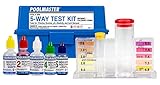
Accurate readings make every chlorine, pH, alkalinity, calcium, and CYA dose safer.
View on Amazon
Raises calcium hardness to reduce corrosive water risk in plaster, concrete, and equipment.
View on Amazon
Raises total alkalinity so pH is less likely to bounce around after treatment.
View on AmazonGet exact pool chemical doses
Pool Chemical Calculator turns your test readings, pool volume, and target levels into exact treatment amounts for chlorine, pH, alkalinity, calcium, stabilizer, salt, and more.
Open the Pool Chemical Calculator app for iOS, Android, or web.