
Pool Winter Cover Water Bags: How to Choose, Calculate, and Install the Right Ones for Your Pool
How to Calculate the Number of Water Bags You Need
Here’s the straightforward math:
Quick answer
Pool Winter Cover Water Bags: How to Choose, Calculate, and Install the Right Ones for Your Pool: How to Calculate the Number of Water Bags You Need Here's the straightforward math: Step 1: Calculate Your Pool's Perimeter Rectangle: (Length + Width) × 2 Example: 16' × 32' pool = (16 + 32) × 2 = 96 feet Round.
Step 1: Calculate Your Pool’s Perimeter
Rectangle: (Length + Width) × 2
- Example: 16′ × 32′ pool = (16 + 32) × 2 = 96 feet
Round: Diameter × 3.14
- Example: 24′ round pool = 24 × 3.14 = 75.4 feet
Oval: (Length × 2) + (Width × 3.14)
- Example: 15′ × 30′ oval = (30 × 2) + (15 × 3.14) ≈ 107 feet
Step 2: Account for Bag Overlap
Water bags should overlap by about 6-12 inches. Using 8-foot bags? Figure each bag covers about 7 effective feet after overlap. Using 10-foot bags? Count on about 9 effective feet.
Step 3: Do the Division
For 8-foot bags: Perimeter ÷ 7 = number of bags
For 10-foot bags: Perimeter ÷ 9 = number of bags
Step 4: Add 1-2 Extra Bags
Always buy a couple spares. A bag will fail mid-winter (it’s inevitable), and you don’t want to hunt for replacements in February.
Quick reference for common pools:
| Pool Size | 8-ft Bags Needed | 10-ft Bags Needed |
|———–|——————|——————-|
| 14′ × 28′ Rectangle | 12-13 bags | 10 bags |
| 16′ × 32′ Rectangle | 14-15 bags | 11-12 bags |
| 18′ × 36′ Rectangle | 16-17 bags | 13 bags |
| 20′ × 40′ Rectangle | 18-19 bags | 14-15 bags |
| 24′ Round | 11-12 bags | 9 bags |
| 15′ × 30′ Oval | 16-17 bags | 13 bags |
How to Fill and Install Water Bags Correctly
Here’s where most people mess up. Get this right and your cover stays secure all winter.
Filling Your Water Bags
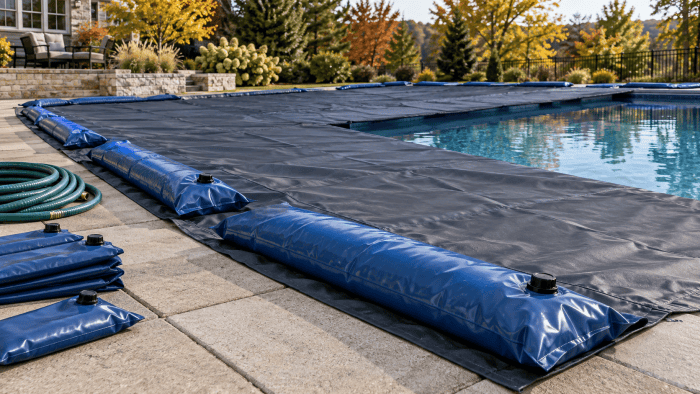
The golden rule: Fill bags 1/2 to 3/4 full. Never more.
Why not fill them completely? Water expands when it freezes. A bag filled to 100% has nowhere to go when temperatures drop, and it’ll split at the seams.
Step-by-step filling process:
- Lay the bag flat on your pool deck or lawn
- Insert your garden hose into the fill valve
- Fill to 1/2-3/4 capacity (eyeball it — the bag should look somewhat flat, not bulging)
- Remove the hose and let any air escape through the valve
- Secure the valve cap tightly
- Flip the bag to check for leaks before positioning
Pro tip: Fill bags a few days before you need them. Any slow leaks will reveal themselves, and you can exchange defective bags before closing day.
Proper Placement Around Your Cover
Position matters as much as quantity.
For rectangular pools:
- Start at the corners — place corner bags first
- Work along the longest sides, overlapping bags by 6-12 inches
- Thread bags through cover loops if your cover has them
- Keep bags centered on the pool edge, not hanging over into the yard
For round pools:
- Space bags evenly around the perimeter
- Create a slight overlap between each bag
- On above-ground pools, drape bags over the pool wall slightly for extra holding power
Spacing guidelines:
- Standard conditions: Bags touching with slight overlap
- High-wind areas: Double up bags in exposed sections
- Corners and curves: Add extra bags where cover material bunches
Troubleshooting Common Water Bag Problems
Problem: Bags Keep Rolling Off the Cover
Solution: You’re either overfilling (making them too round) or using single-chamber bags in a windy area. Switch to double-chamber bags and fill to 1/2 capacity for a flatter profile.
Problem: Bags Are Leaking After One Season
Solution: Look for heavy-duty bags with 20-gauge vinyl minimum. Cheap 16-gauge bags won’t last. Store bags completely dry in a climate-controlled space — UV damage and moisture cause most premature failures.
Problem: Animals Are Destroying the Bags
Solution: Raccoons and squirrels love chewing vinyl. Switch to winter cover blocks or spray bags with a critter deterrent. Some pool owners have success with cayenne pepper around the perimeter.
Problem: Bags Froze and Burst
Solution: You overfilled them. Replace the damaged bags and remember: never fill past 3/4 capacity.
Problem: The Valve Won’t Open in Spring
Solution: Soak the valve area in warm water for 5 minutes to loosen any debris or ice residue. A drop of silicone lubricant on valves before storage prevents this issue.
Water Bags vs. Winter Cover Blocks: The Real Comparison
| Factor | Water Bags | Winter Cover Blocks |
|——–|————|———————|
| Initial Cost (16′ × 32′ pool) | ~$50-80 | ~$200-300 |
| Expected Lifespan | 3-5 seasons | 8-12 seasons |
| Puncture Resistance | Low-Medium | High |
| Curved Edge Performance | Excellent | Good |
| Wind Resistance | Good | Very Good |
| Storage Space | Low (stack flat) | Medium (stackable but bulky) |
| Cost Per Season | ~$15-25 | ~$20-35 |
My take: If you’re in a mild climate with a standard rectangular pool, traditional water bags are fine. Replace them every few years and move on. But if you deal with harsh winters, critter problems, or hate replacing bags constantly, invest in winter cover blocks. The upfront cost stings, but you’ll break even by year 5.
Affiliate disclosure: As an Amazon Associate, Pool Chemical Calculator may earn from qualifying purchases.
Related pool closing tools
Before you install water bags, balance the water so the cover is protecting clean, stable water all winter. Use the pool volume calculator if you need gallons, the chlorine calculator before closing shock, and the pH calculator to get into the right closing range.
For phone-friendly dosing at the pool pad, use the smart app link: Pool Chemical Calculator app.
Sources
- Leslie’s Pool: Tips for Installing Water Bags — Detailed installation guidance and filling recommendations
- PoolSupplies.com: Water Bags Buyer’s Guide — Comparison of bag types and FAQ
- Leslie’s Pool: Water Bags vs. Winter Cover Blocks — Product comparison and durability information
- Doheny’s: How to Use Single Chamber Water Tubes — Step-by-step filling instructions
Frequently Asked Questions
How many water bags do I need for a 16 × 32 pool?
For a 16′ × 32′ rectangular pool (96-foot perimeter), you’ll need approximately 13-15 eight-foot water bags or 10-12 ten-foot bags. This accounts for the recommended overlap of 6-12 inches between bags. Add 1-2 extra bags as spares for mid-winter replacements.
Can I use antifreeze in my pool water bags?
You can, but it’s usually unnecessary. Standard water bags are designed to handle freezing when filled to 1/2-3/4 capacity because there’s room for ice expansion. If you’re in an area with extreme cold (below -20°F) and experiencing burst bags despite proper fill levels, adding RV antifreeze (not automotive) can help. Mix about 1 part antifreeze to 3 parts water.
What’s the difference between single and double-chamber water bags?
Single-chamber bags have one continuous tube — if punctured, you lose all the water. Double-chamber bags have two separate compartments, so a puncture only drains half the bag. Double-chamber bags also lay flatter and resist rolling in wind. They cost more but last longer and perform better in harsh conditions.
How far apart should pool cover water bags be placed?
Water bags shouldn’t have gaps between them — they should overlap by 6-12 inches. For windy areas, increase overlap or double up bags on exposed sides of the pool. The goal is continuous weight around the entire perimeter to prevent any section of cover from lifting.
How long do pool water bags last?
Quality water bags (20-gauge vinyl or thicker) typically last 3-5 seasons with proper care. Cheaper bags may only survive 1-2 seasons. Store bags dry, out of direct sunlight, and away from rodents to maximize lifespan. Winter cover blocks last 8-12 years.
Get Your Pool Chemistry Right Year-Round
Winterizing your pool cover is just one piece of the puzzle. Whether you’re closing for the season or getting ready for spring opening, accurate water chemistry keeps your pool healthy and extends equipment life.
Use our free Pool Chemical Calculator to balance your chlorine, pH, alkalinity, and more — no guesswork required.
Recommended pool supplies
As an Amazon Associate, Pool Chemical Calculator earns from qualifying purchases.

Accurate readings make every chlorine, pH, alkalinity, calcium, and CYA dose safer.
View on Amazon
Protects chlorine from sunlight, especially in outdoor pools with low stabilizer.
View on Amazon
Raises total alkalinity so pH is less likely to bounce around after treatment.
View on AmazonGet exact pool chemical doses
Pool Chemical Calculator turns your test readings, pool volume, and target levels into exact treatment amounts for chlorine, pH, alkalinity, calcium, stabilizer, salt, and more.
Open the Pool Chemical Calculator app for iOS, Android, or web.