
Should You Shock a Pool Before Closing? The Complete Winter Prep Guide
Quick answer
Yes, you should usually shock a pool before closing, but only after the water is clean and balanced. Shock 24-48 hours before covering the pool, circulate overnight, then let chlorine drift back to a safe range before adding winter algaecide or installing the cover. Do not close over green, cloudy, or debris-filled water; shock works best when the pool is already brushed, vacuumed, and properly balanced.
Quick answer
Should You Shock a Pool Before Closing? The Complete Winter Prep Guide: Quick answer Yes, you should usually shock a pool before closing, but only after the water is clean and balanced. Shock 24-48 hours before covering the pool, circulate overnight, then let chlorine drift back to a safe.
Here’s a question that divides pool owners every fall: should you shock a pool before closing, or is it just an extra step that wastes chemicals? The short answer is yes — shocking your pool before winterization is one of the smartest moves you can make. But the amount of shock, the type you choose, and your timing all matter more than most guides tell you.
I’ve seen pool owners dump in a random amount of shock the morning they close, slap on the cover, and hope for the best. Come spring? Green swamp water and a $200+ chemical bill to fix it. Others obsess over precise measurements when their pool didn’t really need that much attention in the first place.
The truth sits somewhere in the middle, and it depends on factors most articles gloss over: your current water condition, what kind of cover you’re using, and even your local climate.
What We Analyzed: Winter Shock Dosage Decision Matrix
To give you actionable guidance instead of vague advice, I built a decision matrix that accounts for real-world variables. This isn’t based on user surveys — it’s calculated from manufacturer recommendations and established industry dosing standards, then adjusted for the conditions that actually affect how much sanitizer your pool needs over winter.
How to Use This Matrix
Find your pool’s current water condition in the left column, then cross-reference with your cover type. The dosage shown is per 10,000 gallons of pool water.
| Water Condition | Solid/Opaque Cover | Mesh/Safety Cover | No Cover |
|—————–|——————-|——————-|———-|
| Clear, balanced water | 1 lb granular shock OR 1 gallon liquid | 1.5 lbs granular OR 1.5 gallons liquid | 2 lbs granular OR 2 gallons liquid |
| Slightly cloudy, no visible algae | 2 lbs granular OR 2 gallons liquid | 2.5 lbs granular OR 2.5 gallons liquid | 3 lbs granular OR 3 gallons liquid |
| Visible algae or green tint | 3-4 lbs granular OR 3-4 gallons liquid | 4 lbs granular OR 4 gallons liquid | Not recommended — clear algae first |
Methodology: These dosages are derived from common manufacturer guidelines (typically 1 lb calcium hypochlorite per 10,000 gallons for maintenance shocking) and adjusted upward based on contamination level and cover porosity. Mesh covers allow more debris, sunlight, and organic matter through, which consumes sanitizer faster. Pools without covers face even greater exposure.
Limitations: This matrix provides starting-point recommendations, not precise prescriptions. Your specific results may vary based on CYA (stabilizer) levels, water temperature at closing, and how long your winter season lasts. Always test your water before and after shocking to confirm adequate sanitizer levels.
Quick Reference: Pool Volume Calculations
Not sure about your pool’s volume? Here’s how to calculate it:
- Rectangular pools: Length × Width × Average Depth × 7.5 = gallons
- Round pools: Diameter × Diameter × Average Depth × 5.9 = gallons
- Oval pools: Length × Width × Average Depth × 6.7 = gallons
A typical 16×32 foot rectangular pool with an average depth of 5 feet holds about 19,200 gallons. Using the matrix above, if the water is clear and you’re using a solid cover, you’d need roughly 2 lbs of granular shock.
Why Shocking Before Closing Actually Matters
Think of shocking like deep-cleaning your refrigerator before a two-week vacation. Sure, you could skip it — but anything left behind has months to grow into something unpleasant.
When you shock your pool, you’re doing three things:
- Killing existing bacteria and algae spores that testing might not detect
- Oxidizing organic contaminants — sweat, sunscreen, leaves, and other debris that accumulated during swim season
- Creating a sanitizer reserve that continues working under the cover
That last point is crucial. Your pool doesn’t stop being a pool just because you covered it. Organic matter breaks down. Bacteria multiply. Algae spores wait for their chance. A proper shock dose creates enough residual chlorine to handle these threats for weeks — sometimes months — before levels drop to zero.
The Real Cost of Skipping This Step
Opening a neglected pool in spring typically requires 3-5 times more shock than closing would have taken. Add algaecide, clarifier, and the extra filter runtime, and you’re looking at $150-300 in extra costs. Plus the frustration of waiting 1-2 weeks for the water to clear while the weather turns warm.
One good shock treatment at closing? Maybe $15-25 in chemicals.
Chlorine Shock vs. Non-Chlorine Shock: Which Should You Use?
This decision trips up a lot of pool owners. Both types exist for good reasons, but they’re not interchangeable for winterization.
Calcium Hypochlorite (Cal-Hypo) Granular Shock
This is your go-to for winter closing. Cal-hypo delivers 65-75% available chlorine, which means serious killing power against algae and bacteria. It dissolves reasonably quickly and leaves behind a chlorine residual that keeps working.
Best for: Most winterization scenarios, especially if you’ve had any algae issues during the season
Considerations: Raises calcium hardness slightly over time. If your water already runs high on calcium (above 350 ppm), factor this in.
A solid option is In The Swim Calcium Hypochlorite Pool Shock — it’s concentrated and designed specifically for this purpose.
Liquid Chlorine (Sodium Hypochlorite)
Liquid chlorine works well for closing because it doesn’t add calcium to your water and disperses evenly without pre-dissolving. The downside? It’s bulkier to store and transport, and it loses potency faster than granular products.
Best for: Pools with high calcium hardness, or if you prefer easier mixing
Non-Chlorine Shock (Potassium Monopersulfate)
Here’s where most guides get it wrong: non-chlorine shock is an oxidizer, not a sanitizer. It breaks down organic contaminants but doesn’t kill bacteria or algae effectively on its own.
For winterization, non-chlorine shock alone is insufficient. It works as a supplemental treatment or for regular mid-season maintenance, but your closing shock needs to be chlorine-based.
The Right Timing: When Exactly to Shock
Timing matters more than most pool owners realize. Shock too early, and the chlorine dissipates before you close. Shock too late, and you risk covering the pool before the chemicals have circulated properly.
The 24-48 Hour Window
Here’s the sequence that works:
Day 1 (Evening): Add your shock treatment after the sun goes down. UV light destroys chlorine rapidly — shocking at dusk gives the chemicals 8-12 hours of protected work time.
Day 2: Run your pump for at least 8 hours (overnight is ideal if your equipment allows). This circulates the shock throughout the entire pool, including dead spots behind ladders and in corners.
Day 2 (Afternoon/Evening): Test the water. You’re looking for free chlorine between 1-3 ppm and combined chlorine at 0.5 ppm or less. If levels are still extremely high (above 10 ppm), wait another day before adding algaecide or closing.
Day 2 or 3: Add winterizing algaecide, then complete your closing process and install the cover.
Why the Wait Before Adding Algaecide?
Chlorine levels above 5 ppm can degrade algaecide, wasting your money and reducing its effectiveness. The 24-hour window gives chlorine time to do its sanitizing work and drop to levels where algaecide can remain stable throughout winter.
A quality winterizing algaecide like Pool Mate Winter Pool Algaecide is designed to last for months, but only if chlorine doesn’t destroy it right away.
Water Chemistry: What to Balance Before Shocking
Shocking works best when your water chemistry is already in range. Out-of-balance water can reduce shock effectiveness or even cause damage.
Pre-Shock Chemistry Targets
| Parameter | Ideal Range for Closing |
|———–|————————|
| pH | 7.2 – 7.6 |
| Total Alkalinity | 80 – 120 ppm |
| Calcium Hardness | 200 – 400 ppm |
| Cyanuric Acid (CYA) | 30 – 50 ppm |
pH is the priority. Chlorine’s killing power drops dramatically when pH climbs above 7.8. At pH 8.0, chlorine is only about 20% as effective as it is at pH 7.2. All that shock you’re adding? It’s barely working.
Test and adjust pH first, then alkalinity, then shock.
The CYA Factor Most Guides Ignore
Cyanuric acid (stabilizer) protects chlorine from UV degradation — useful during swim season, but less relevant when the pool is covered. Here’s what matters for closing:
- CYA below 30 ppm: Your shock will dissipate quickly even under a cover if any sunlight penetrates. Consider the higher end of dosing recommendations.
- CYA between 30-50 ppm: Ideal range. Standard dosing applies.
- CYA above 80 ppm: Chlorine effectiveness decreases significantly. You may need 2-3x the normal shock dose to achieve the same sanitizing effect.
If your CYA is extremely high (100+ ppm), partially draining and refilling with fresh water before closing is often cheaper than adding massive amounts of shock.
Special Scenarios: Adjusting Your Approach
Not every pool closing is straightforward. Here’s how to handle common complications.
Closing with Existing Algae
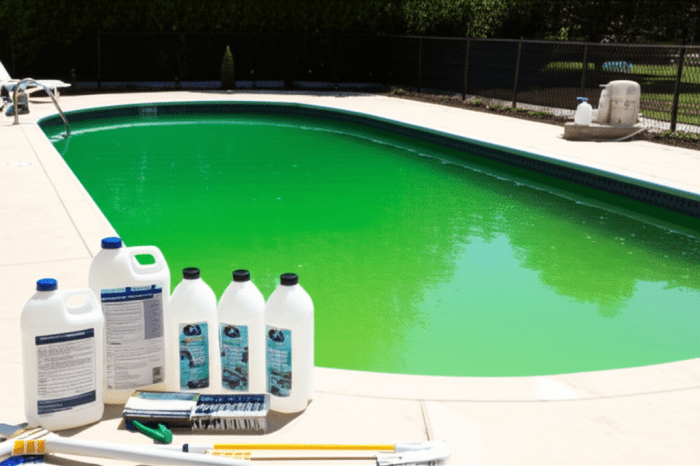
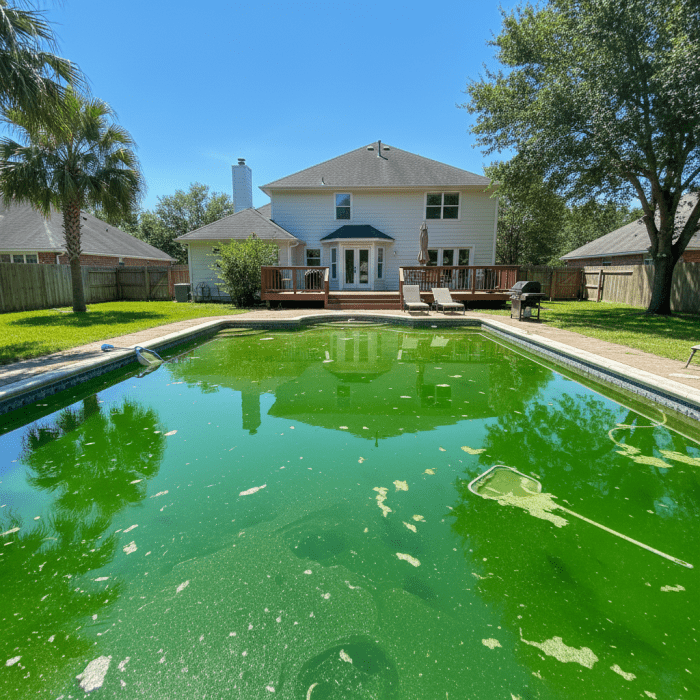
If you can see green, yellow, or black algae, shocking at normal winterization doses won’t cut it. You need to treat the algae before closing, not during.
For light green algae:
- Brush all surfaces thoroughly
- Add 3-4 lbs of cal-hypo shock per 10,000 gallons
- Run the filter 24-48 hours continuously
- Vacuum dead algae to waste (not through the filter)
- Retest and proceed with normal closing if water is clear
For heavy algae blooms: Consider delaying closing until you’ve fully cleared the problem. Closing on active algae almost guarantees a swamp in spring.
Late-Season Closing (Water Below 50°F)
Cold water slows chemical reactions, including chlorine’s sanitizing action. But it also slows algae and bacteria growth dramatically. This creates an interesting tradeoff.
If you’re closing when water temperature is below 50°F and the water is crystal clear with balanced chemistry, you can often reduce shock dosage by 25-30%. The cold acts as a natural preservative.
Caution: This only applies if closing conditions are perfect. Any cloudiness, any chemistry issues — use full dosage.
Mesh Covers and Extended Exposure
Mesh safety covers allow water, debris, and some sunlight through. This means:
- More organic matter entering the pool over winter
- Faster chlorine degradation from UV exposure
- Higher likelihood of algae if temperatures fluctuate
Increase your shock dose by 50% compared to solid cover recommendations. Adding a second dose of algaecide mid-winter (during a warm spell) can also help, but this requires partially removing the cover.
Step-by-Step: Complete Shocking Procedure for Closing
Here’s the exact process I recommend, condensed into actionable steps:
Supplies Needed
- Test kit or test strips
- Granular calcium hypochlorite shock (or liquid chlorine)
- 5-gallon bucket (for pre-dissolving granular shock)
- Rubber gloves and eye protection
- Stir stick or brush handle
- Winterizing algaecide
- Pool brush for final scrubbing
The Process
Step 1: Test and adjust pH
Test your water and adjust pH to 7.2-7.6. Wait 4-6 hours after pH adjustment before adding shock.
Step 2: Calculate your shock dose
Use the matrix above, based on pool volume, water condition, and cover type.
Step 3: Pre-dissolve granular shock
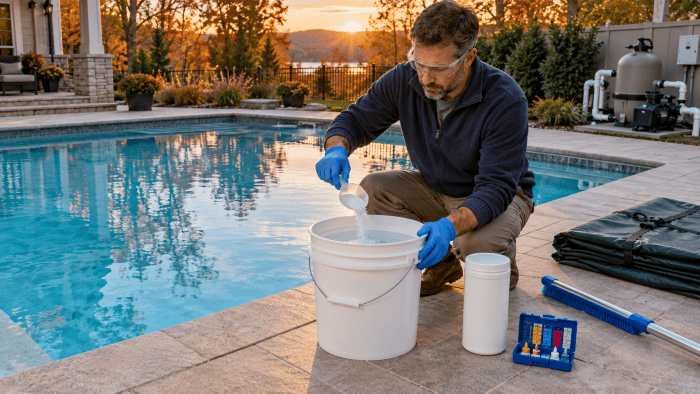
Pre-dissolve granular shock in a bucket of pool water. Never add shock directly to the pool because undissolved granules can bleach liners or etch plaster. Use approximately 1 gallon of water per pound of shock.
Step 4: Add shock with the pump running
With the pump running, slowly pour the dissolved shock around the pool perimeter. Avoid pouring in one spot.
Step 5: Brush all pool surfaces
Brush walls, floor, steps, and behind ladders. This ensures shock reaches every area and dislodges any early-stage algae.
Step 6: Circulate overnight
Run the pump for 8-24 hours. Overnight is ideal.
Step 7: Retest before algaecide
The next day, test chlorine levels. Wait until free chlorine drops below 5 ppm before adding algaecide.
Step 8: Add winter algaecide
Add winterizing algaecide per product instructions.
Step 9: Finish closing the pool
Complete remaining closing tasks: lowering water level, blowing out lines, plugging returns, and installing the cover.
Common Mistakes That Sabotage Winter Shocking
Avoid these pitfalls that I see repeatedly:
Shocking and covering immediately. The shock needs time to circulate and do its job. Covering within an hour traps concentrated chemicals in one area while leaving dead spots unprotected.
Adding shock and algaecide simultaneously. High chlorine destroys algaecide. Always shock first, wait for levels to drop, then add algaecide.
Using old shock. Calcium hypochlorite loses potency over time, especially if moisture gets into the container. If your shock is from two seasons ago, test a small amount in a bucket first or just buy fresh.
Forgetting to brush. Algae spores cling to surfaces. Shocking the water without brushing is like disinfecting a kitchen counter without wiping it first.
Ignoring CYA levels. High stabilizer renders shock ineffective. Test CYA before closing and address it if necessary.
Frequently Asked Questions
Is it necessary to shock my pool if the water is already crystal clear?
Yes, but you can use the lower end of recommended doses. Clear water can still contain bacteria and algae spores that aren’t visible. Even a maintenance dose of shock (1 lb per 10,000 gallons) provides important protection over winter. Think of it as insurance — the cost is low, and the protection is significant.
How long should I run the pump after shocking before closing?
Minimum 8 hours, but 12-24 hours is better. This ensures the shock circulates completely throughout the pool, reaching corners, dead spots, and areas behind ladders. Running the pump overnight after an evening shock treatment works perfectly.
Can I use non-chlorine shock to winterize my pool?
Non-chlorine shock alone isn’t sufficient for winterization. It’s an oxidizer that removes contaminants but doesn’t sanitize effectively against bacteria and algae. You need chlorine-based shock (calcium hypochlorite or liquid chlorine) to properly protect your pool through winter. Non-chlorine shock can be used as a supplement, not a replacement.
What happens if I add too much shock before closing?
Excess shock isn’t dangerous to the pool itself, but extremely high chlorine levels (20+ ppm) can damage certain cover materials if the cover sits directly on the water. Very high chlorine also wastes money since it will dissipate before providing additional benefit. If you accidentally over-shock, wait an extra day before covering and allow levels to drop to under 10 ppm.
Does cold water temperature affect how much shock I should add?
Cold water (below 50°F) slows both chlorine activity and algae/bacteria growth. If your pool is closing with crystal clear water, balanced chemistry, and temperatures below 50°F, you can reduce shock by 25-30%. But if any conditions are less than perfect, use the full recommended dose — the margin for error disappears in cold water because the shock works more slowly.
Ready to Calculate Your Exact Dose?
Getting your shock dosage right is just one piece of proper pool chemistry. For precise calculations on shock, pH adjustments, alkalinity, and more — try our free Pool Chemical Calculator. Just enter your pool volume and current readings, and you’ll get exact amounts for any chemical adjustment.
A few minutes of accurate calculation beats hours of troubleshooting an off-balance pool every time.
Pool Closing Supplies Worth Having
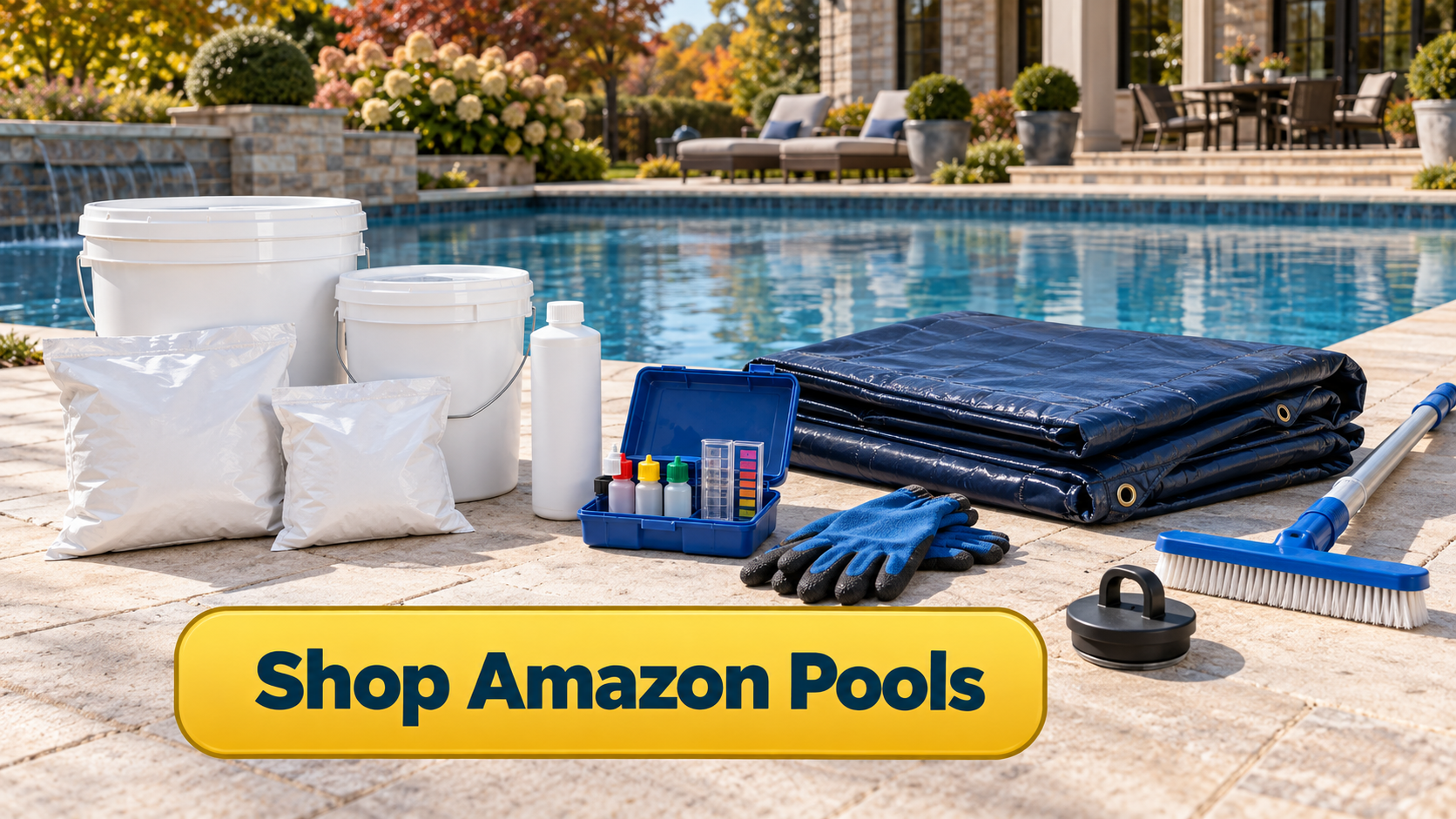
Disclosure: As an Amazon Associate, Pool Chemical Calculator may earn from qualifying purchases. Useful supplies include pool shock, polyquat winter algaecide, pool test kits, and winter pool covers.
Sources
- CDC: Operating public swimming pools
- Hayward: How to close your pool
- Leslie’s: How to close a pool
- In The Swim: Pool shock guide
Final Takeaway
Shock before closing if the pool is clean, balanced, and ready to circulate for several hours. Do it 24-48 hours before the cover goes on, wait for chlorine to drift down before adding algaecide, and never use closing shock as a shortcut for untreated algae. Use the Pool Chemical Calculator app to calculate exact shock, pH, alkalinity, calcium, and stabilizer doses from your own pool volume and test readings.
Recommended pool supplies
As an Amazon Associate, Pool Chemical Calculator earns from qualifying purchases.

Raises free chlorine quickly without adding stabilizer, which is useful when CYA is already high.
View on Amazon
Accurate readings make every chlorine, pH, alkalinity, calcium, and CYA dose safer.
View on Amazon
Brushing breaks up algae films, dead spots, and wall buildup so chemicals and filtration work.
View on AmazonGet exact pool chemical doses
Pool Chemical Calculator turns your test readings, pool volume, and target levels into exact treatment amounts for chlorine, pH, alkalinity, calcium, stabilizer, salt, and more.
Open the Pool Chemical Calculator app for iOS, Android, or web.