
How to Vacuum Your Pool Manually: The Complete Step-by-Step Guide
Quick Answer
To vacuum a pool manually, attach the vacuum head to a telescopic pole, connect and fully prime the vacuum hose, attach the hose to the skimmer or vacuum port, then move the vacuum head slowly across the floor with overlapping passes. For normal dirt, vacuum on the filter setting. For algae, mud, flocculant, or heavy debris, vacuum to waste, refill as you go, and retest the water afterward with the Pool Chemical Calculator app.
Quick answer
How to Vacuum Your Pool Manually: The Complete Step-by-Step Guide: Quick Answer To vacuum a pool manually, attach the vacuum head to a telescopic pole, connect and fully prime the vacuum hose, attach the hose to the skimmer or vacuum port, then move the vacuum head slowly across the.
There’s something satisfying about manually vacuuming your pool. You control exactly where the suction goes, you can see the debris disappearing in real-time, and honestly? It’s cheaper than buying a $1,200 robotic cleaner. Learning how to vacuum a pool manually isn’t complicated, but there’s a difference between doing it and doing it right. Poor technique stirs up debris instead of removing it, wastes water, and leaves you frustrated. Good technique gives you crystal-clear water in 20-40 minutes.
I’ve vacuumed hundreds of pools over the years. And I can tell you that the biggest mistakes happen before the vacuum head even touches the bottom. Let’s fix that.
What We Analyzed: Manual Pool Vacuuming Scenario Matrix
Before we jump into the how-to, I want to show you something useful. I built a scenario matrix that helps you figure out how often to vacuum, how much water you’ll lose when vacuuming to waste, and what chemical adjustments to expect afterward.
Methodology: This matrix uses standard pump flow rates (40-80 GPM for residential pools), typical vacuuming durations observed in practice, and basic volume calculations. Water loss estimates assume continuous vacuuming at the stated flow rate.
Limitations: Your actual results will vary based on your specific pump, plumbing efficiency, hose diameter, and vacuuming speed. These are planning estimates, not guarantees.
Vacuuming Frequency & Impact Matrix
| Scenario | Debris Load | Environment | Usage | Method | Pump GPM | Recommended Frequency | Est. Water Loss (20 min session) | Post-Vac Chemical Priority |
|———-|————-|————-|——-|——–|———-|———————-|———————————-|—————————|
| A | Light | Open/Sunny | Low | To Filter | N/A | Every 10-14 days | 0 gallons | Check chlorine only |
| B | Moderate | Near Trees | Moderate | To Filter | N/A | Weekly | 0 gallons | Check chlorine, pH |
| C | Moderate | Near Trees | High | To Waste | 50 GPM | Weekly | ~1,000 gallons | Refill, then test all levels |
| D | Heavy | Construction Nearby | Any | To Waste | 50 GPM | 2-3x per week | ~1,000 gallons per session | Refill immediately, full rebalance |
| E | Heavy (algae bloom) | Any | Any | To Waste | 60 GPM | Daily until clear | ~1,200 gallons | Add water during vacuum, shock after |
How to use this: Find the scenario closest to your situation. A 15,000-gallon pool losing 1,000 gallons per “to waste” session drops about 6.7% of its water volume. That’s enough to noticeably affect your chemical balance—especially alkalinity and calcium hardness. If you’re not sure of your gallonage, start with the pool volume calculator, then use the chlorine calculator, pH calculator, and alkalinity calculator after the refill.
Equipment You’ll Need for Manual Pool Vacuuming
You can’t vacuum without the right gear. Here’s what you need:
The Essential Four
- Vacuum head – The weighted base that glides along your pool floor. Concrete pools need heads with wheels or brushes; vinyl pools need softer, brush-style heads to prevent liner damage.
- Telescopic pole – Same pole you use for skimming and brushing. Make sure it locks securely at full extension.
- Vacuum hose – Should be long enough to reach every corner of your pool from the skimmer. For a 16×32 pool, you’ll want at least 35-40 feet of hose.
- Skimmer plate or vacuum plate – This adapter covers your skimmer basket and creates a direct suction path. Some pools have a dedicated vacuum port instead.
Recommended vacuum head for concrete pools: Milliard Pool Vacuum Head – weighted design with side brushes, works well with most pole connections.
For vinyl liner pools: Swimline Weighted Vinyl Vacuum – softer bristles that won’t scratch or puncture your liner.
Optional But Helpful
- Leaf trap canister – Installs inline between your vacuum hose and skimmer. Catches large debris before it clogs your pump basket.
- Skim-Vac plate – Lets you vacuum while keeping your skimmer basket in place. Useful for light debris.
How to Set Up Your Manual Pool Vacuum (The Right Way)
Setup takes 5 minutes. Rushing it costs you 20 minutes of troubleshooting.
Step 1: Attach the Vacuum Head to Your Pole
Push the pole firmly into the vacuum head’s socket and twist to lock. Give it a solid tug—if it comes loose now, it’ll definitely come loose underwater when you’re mid-stroke.
Step 2: Connect the Vacuum Hose
Attach one end of your vacuum hose to the swivel fitting on top of the vacuum head. This connection needs to be snug. A loose hose bleeds air and kills your suction.
Step 3: Lower Everything Into the Pool
Submerge the vacuum head and let it sink to the bottom. Now here’s the critical part: you need to fill the entire hose with water before connecting it to the skimmer.
Step 4: Prime the Hose (Don’t Skip This)
Air in your hose means no suction. Air in your pump means potential damage. Here’s how to get water into every inch of that hose:
Method 1: Return jet technique
Hold the free end of the hose against a return jet. Water pressure forces air out through the vacuum head (you’ll see bubbles rising). Wait until bubbles stop completely—usually 30-60 seconds.
Method 2: Hand-over-hand submersion
Starting at the vacuum head, push the hose underwater section by section. Work your way to the free end, keeping each section submerged. Slower but works when return jets are weak.
Step 5: Connect to the Skimmer
With your thumb sealing the hose end (keeping water in, air out), quickly walk to the skimmer. Remove the skimmer basket, insert the skimmer plate, and firmly push the hose into the plate’s suction hole.
You should immediately feel strong suction pulling at the hose. If suction feels weak, air got in somewhere—disconnect and re-prime.
Proper Vacuuming Technique: Slow Wins the Race
Here’s where most people mess up. They vacuum like they’re trying to win a race. Fast movements stir up debris instead of sucking it in. The dirt cloud settles elsewhere, and you’ve accomplished nothing.
The Correct Approach
Move slowly. I mean painfully slow. Like you’re vacuuming a sleeping baby’s room. Each stroke should take 5-10 seconds.
Use overlapping strokes. Treat it like mowing a lawn. Each pass should overlap the previous one by about 6 inches. Miss a strip, and you’ll see it when the water clears.
Work from shallow to deep. Start at the shallow end and work toward the drain. Debris naturally migrates toward the deep end, so you’re pushing stragglers toward the collection point.
Don’t lift the vacuum head unnecessarily. Every time you pull the head off the bottom, you release debris back into the water. Keep it down, keep it moving.
How Long Should It Take?
For a typical 15,000-gallon residential pool (roughly 16×32 feet):
- Light debris: 15-20 minutes
- Moderate debris: 25-35 minutes
- Heavy debris: 40-60 minutes
If you’re taking longer than an hour, your suction is probably compromised, or you’ve got more debris than manual vacuuming can handle efficiently.
When to Vacuum to Filter vs. Vacuum to Waste
Your multiport valve has several positions. Two matter for vacuuming:
Vacuum to Filter (Normal Position)
Water flows through your filter and returns to the pool. This is your default setting for:
- Regular maintenance vacuuming
- Light debris (dust, pollen, fine sediment)
- When you don’t want to lose water
Downside: Fine debris can pass through and return to the pool. Heavy debris loads can clog your filter fast.
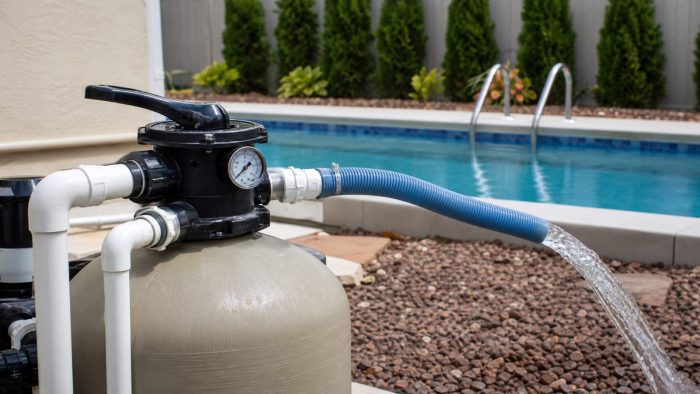
Vacuum to Waste (Bypass Filter)
Water goes straight out your waste line—typically to a sewer drain or into your yard. Use this setting for:
- Algae (you don’t want dead algae spores returning to the pool)
- Heavy debris loads (leaves, construction dust, mud)
- After flocking treatments
- Any time debris is too fine for your filter to catch
Downside: You’re losing water. At 50 GPM, a 20-minute vacuuming session drains about 1,000 gallons. At 60 GPM, that’s 1,200 gallons.
The Water Loss Math
Let’s make this practical. If your pump moves 50 gallons per minute and you vacuum to waste for 20 minutes:
50 GPM × 20 minutes = 1,000 gallons lost
For a 15,000-gallon pool, that’s 6.7% of your total volume. You’ll need to refill, then retest everything—chlorine, pH, alkalinity, calcium hardness. Fresh water typically has different mineral content than your balanced pool water.
Pro tip: When vacuuming to waste, run your garden hose into the pool simultaneously. This maintains water level and saves time on refilling afterward.
Troubleshooting Common Manual Vacuum Problems
Problem: No Suction or Weak Suction
Check first: Is air entering the system? Look for bubbles in the pump basket. Air leaks kill suction.
Common causes:
- Hose not fully primed (re-prime it)
- Hose connection loose at vacuum head or skimmer
- Clogged pump basket (empty it)
- Water level too low (skimmer is gulping air)
- Crack or hole in vacuum hose (inspect full length)
Problem: Vacuum Head Keeps Floating Up
The head isn’t heavy enough for your pool type. Concrete pool? Make sure you’re using a weighted head, not a lightweight vinyl model. You can also add a small dive weight to the head temporarily.
Problem: Vacuum Moves But Doesn’t Pick Up Debris
You’re moving too fast. Slow down by half. Still not working? Check if your filter is completely clogged (no water flow = no suction at the head).
Problem: Losing Suction Mid-Vacuum
Your pump basket or skimmer basket filled up. Stop, empty baskets, re-prime, and continue. With heavy debris, you might need to empty baskets 2-3 times per session.
Post-Vacuuming Checklist
You’re not done when the debris is gone. Here’s what happens next:
- Disconnect the hose – Pull it from the skimmer slowly to avoid back-splashing dirty water.
- Drain the hose – Lift one end and walk it to the other, forcing water out. Leaving water in the hose breeds bacteria and degrades the material.
- Replace skimmer basket – Don’t leave your skimmer open.
- Check your filter pressure – If it jumped more than 8-10 PSI from baseline, backwash or clean your filter.
- Test water chemistry – Especially after vacuuming to waste. Use our Pool Chemical Calculator app to figure out exactly what to add. If the water still looks dull, check the pool chemical forecast before adding more sanitizer.
- Run the pump – Keep it running for at least 4-6 hours after vacuuming to filter any remaining particles.
Manual vs. Automatic: When Does Manual Make Sense?
Manual vacuuming isn’t obsolete. It’s actually better than automatic cleaners in specific situations:
- Algae outbreaks – Robotic cleaners spread algae. Manual vacuuming to waste removes it permanently.
- Targeted cleaning – That one corner where leaves collect? Faster to manually vacuum for 5 minutes than deploy a robot for an hour.
- Post-storm cleanup – Heavy debris loads overwhelm automatic cleaners. Manual gets it done.
- Budget situations – A quality manual setup costs $40-80. Decent robotic cleaners start at $300.
For routine maintenance with light debris? Automatic cleaners save time. For problem-solving and heavy debris? Nothing beats manual control.
Sources
- AstralPool Australia: Using a Manual Pool Vacuum – Detailed breakdown of equipment and basic technique
- Premier Pools: How to Manually Vacuum Your Pool – Step-by-step guide with visual references
- INYOPools: How to Manually Vacuum a Pool – Troubleshooting focus and equipment recommendations
- SwimmingPool.com: Vacuum a Pool – Comprehensive overview of vacuuming methods
Frequently Asked Questions
How often should I manually vacuum my pool?
For most pools with moderate tree coverage and average use, weekly vacuuming keeps things clean. Light-use pools in open areas can stretch to every 10-14 days. Pools near construction, under heavy tree cover, or after storms may need vacuuming 2-3 times per week until conditions improve.
Why does my pool vacuum lose suction after a few minutes?
Usually, it’s a full basket. When your pump basket or skimmer basket fills with debris, water flow drops and suction dies. Stop vacuuming, empty both baskets, re-prime your hose, and continue. Less commonly, the problem is a crack in your vacuum hose or a loose connection letting air in.
Can I vacuum my pool with the pump off?
No. Your pump creates the suction that makes vacuuming work. Without the pump running, you’re just pushing a weighted head around the bottom. Always ensure your pump is running before connecting the vacuum hose to the skimmer.
How much water do I lose when vacuuming to waste?
It depends on your pump’s flow rate and how long you vacuum. A typical residential pump moves 40-60 gallons per minute. At 50 GPM for 20 minutes, you’ll lose about 1,000 gallons. For a 15,000-gallon pool, that’s nearly 7% of your water—enough to require refilling and chemical rebalancing.
Should I brush my pool before or after vacuuming?
Before. Brushing loosens algae and debris from walls and floor, making it easier for the vacuum to pick up. Wait 15-20 minutes after brushing to let debris settle before you start vacuuming. Otherwise, you’re chasing particles suspended in the water column.
Get Your Chemistry Right After Vacuuming
Manual vacuuming removes debris, but it doesn’t balance your water. After every vacuuming session—especially after vacuuming to waste—you need to test and adjust your chemicals.
Use the free Pool Chemical Calculator app to know exactly how much chlorine, pH adjuster, or alkalinity increaser your pool needs. Just enter your test results and pool volume, and we’ll tell you the precise amounts to add.
No guessing. No overchemicalizing. Just clear, balanced water.
Recommended pool supplies
As an Amazon Associate, Pool Chemical Calculator earns from qualifying purchases.

Helpful for spot-cleaning settled debris, dead algae, and problem areas after treatment.
View on Amazon
Accurate readings make every chlorine, pH, alkalinity, calcium, and CYA dose safer.
View on Amazon
Saves manual cleaning time and helps keep floors and walls cleaner between service visits.
View on AmazonGet exact pool chemical doses
Pool Chemical Calculator turns your test readings, pool volume, and target levels into exact treatment amounts for chlorine, pH, alkalinity, calcium, stabilizer, salt, and more.
Open the Pool Chemical Calculator app for iOS, Android, or web.